Advertisements
Advertisements
प्रश्न
A symmetric double convex lens is cut in two equal parts by a plane containing the principal axis. If the power of the original lens was 4 D, the power of a divided lens will be
विकल्प
2 D
3 D
4 D
5 D.
Advertisements
उत्तर
4 D
As the lens is cut along the principal axis, the two new lens will act as two double convex lenses. Even after cutting the lens, the radius of the curvature of the two new lens will remain the same as that of the original lens, with the power equal to the original lens.
APPEARS IN
संबंधित प्रश्न
What is meant by a power of a lens? Define its SI unit.
The lens mentioned in 6(b) above is of focal length 25cm. Calculate the power of the lens.
Kavita from 10th is using spectacles. The power of the lenses in her spectacles is –2.5 dioptre. Answer the following questions:
1) Which lenses are used in her spectacles?
2) State the defect of vision Kavita is suffering from.
3) Find the focal length of the lenses used in her spectacles
A student uses a lens of focal length 40 cm and another of –20 cm. Write the nature and power of each lens
A doctor has prescribed a corrective lens of power, −1.5 D. Find the focal length of the lens. Is the prescribed lens diverging or converging?
A diverging lens has a focal length of 0.10 m. The power of this lens will be:
The power of a lens is +2.0D. Its focal length should be :
State the condition for the following a ray passes undeviated through the lens .
On reducing the focal length of a lens, its power ______.
Express the power (with sign) of a concave lens of focal length 20 cm.
A normal eye is not able to see objects closer than 25 cm because
A double convex lens has two surfaces of equal radii R and refractive index \[m = 1 \cdot 5\]
A screen is placed a distance 40 cm away from an illuminated object. A converging lens is placed between the source and the screen and its is attempted to form the image of the source on the screen. If no position could be found, the focal length of the lens
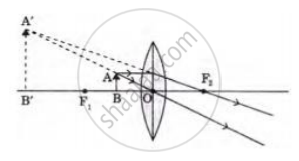
The above lens has a focal length of 10 cm. The object of height 2 mm is placed at a distance of 5 cm from the pole. Find the height of the image.
A point object is placed at O in front of a glass sphere as shown in figure.

Show the formation of the image by the sphere.
The same size images are formed by a convex lens when the object is placed at 20 cm or at 10 cm from the lens. The focal length of convex lens is ______ cm.
When monochromatic red light is used instead of blue light in a convex lens, its focal length will ______.
The focal length of a double convex lens is equal to the radius of curvature of either surface. What is the refractive index of its material?
If the lens material and the surrounding liquid have the same refractive index (\[n_2 = n_1\]), then:
