Please select a subject first
Advertisements
Advertisements
Can displacement be zero even if the distance is not zero? Give one example to explain your answer.
Concept: undefined >> undefined
When is the magnitude of displacement equal to the distance?
Concept: undefined >> undefined
Advertisements
A body when projected up with an initial velocity u goes to a maximum height h in time t and then comes back at the point of projection. The correct statement is ______________
Concept: undefined >> undefined
A train takes 3 h to travel from Agra to Delhi with a uniform speed of 65 km h-1. Find the distance between the two cities.
Concept: undefined >> undefined
What information about the motion of a body are obtained from the displacement-time graph?
Concept: undefined >> undefined
Can displacement-time sketch be parallel to the displacement axis? Give a reason to your answer.
Concept: undefined >> undefined
State how the velocity-time graph can be used to find The distance travelled by the body in a given time
Concept: undefined >> undefined
State how the velocity-time graph can be used to find The displacement of the body in a given time.
Concept: undefined >> undefined
What can you say about the nature of motion of a body if its displacement-time graph is A straight line parallel to the time axis?
Concept: undefined >> undefined
What can you say about the nature of motion of a body if its displacement-time graph is A straight line inclined to the time axis with an acute angle?
Concept: undefined >> undefined
What can you say about the nature of motion of a body if its displacement-time graph is A straight line inclined to the time axis with an obtuse angle?
Concept: undefined >> undefined
What can you say about the nature of motion of a body if its displacement-time graph is A curve.
Concept: undefined >> undefined
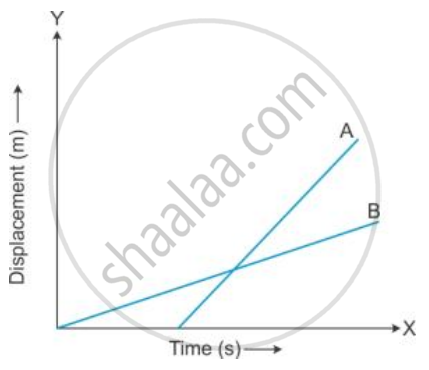
Figure shows the displacement-time graph of two vehicles A and B moving along a straight road. Which vehicle is moving faster? Give reason.
Concept: undefined >> undefined
Draw a velocity-time graph for a body moving with an initial velocity u and uniform acceleration a. Use this graph to find the distance travelled by the body in time t.
Concept: undefined >> undefined
How is the distance related with time for motion under uniform acceleration such as the motion of a freely falling body?
Concept: undefined >> undefined
The following table gives the displacement of a car at different instants of time.
| Time (s) | 0 | 1 | 2 | 3 | 4 |
| Displacement (m) | 0 | 5 | 10 | 15 | 20 |
- Draw the displacement-time sketch and find the average velocity of the car.
- What will be the displacement of the car at (i) 2.5 s and (ii) 4.5 s?
Concept: undefined >> undefined
A body is moving in a straight line and its displacement at various instants of time is given in the following table
| Time (s) | 0 | 1 | 2 | 3 | 4 | 5 | 6 | 7 |
| Displacement (m) | 2 | 6 | 12 | 12 | 12 | 18 | 22 | 24 |
Plot the displacement-time graph and calculate
(i) Total distance travelled in the interval 1 s to 5 s.
(ii) Average velocity in time interval 1 s to 5 s.
Concept: undefined >> undefined
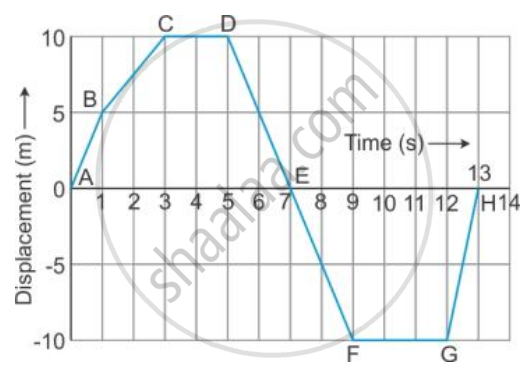
From the displacement-time graph of a cyclist given below in the Figure, find The displacement from the initial position at the end of 10 s,
Concept: undefined >> undefined
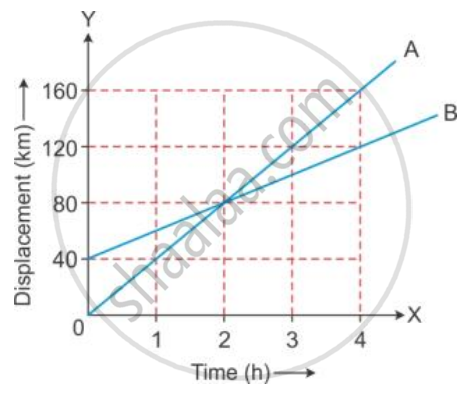
Figure ahead represents the displacement - time sketch of motion of two cars A and B . Find :
(i) the distance by which the car B was initially ahead of car A.
(ii) the velocities of car A and car B.
(iii) the time in which car A catches car B.
(iv) the distance from start when the car A will catch the car B.
Concept: undefined >> undefined
A body at rest is made to fall from the top of a tower. Its displacement at different instants is given in the following table:
| Time (in s) | 0.1 | 0.2 | 0.3 | 0.4 | 0.5 | 0.6 |
| Displacement (in m) | 0.05 | 0.20 | 0.45 | 0.80 | 1.25 | 1.80 |
Draw a displacement-time graph and state whether the motion is uniform or non-uniform?
Concept: undefined >> undefined
