Please select a subject first
Advertisements
Advertisements
Give Reasons for the following.
On sprinkling common salt on grass growing in a lawn, the grass is killed.
Concept: undefined >> undefined
Give Reasons for the following.
The raisins swell up in the water.
Concept: undefined >> undefined
Advertisements
Give Reasons for the following.
We gargle with saline water in case of throat infection.
Concept: undefined >> undefined
Give Reasons for the following.
Freshwater fish cannot survive in seawater.
Concept: undefined >> undefined
Give Reasons for the following.
Drops of water on a leaf of plant like peepal does not enter the leaf by osmosis?
Concept: undefined >> undefined
Give Reasons for the following.
Plants growing in fertilized soil are often found to wilt if the soil is not adequately watered. Why?
Concept: undefined >> undefined
Give Reasons for the following.
Plants begin to die when the excess of soluble fertilizers are added to the soil?
Concept: undefined >> undefined
Differentiate between:
Osmosis and Diffusion
Concept: undefined >> undefined
Differentiate between the following
Endosmosis and Exosmosis
Concept: undefined >> undefined
In the figure below ‘A’ shows a cell in the normal state and ‘B’ shows the same cell after leaving it in a certain solution for a few minutes.

(i) Describe the change which has occurred in the cell as seen in B.
(ii) Give the technical term for the condition of the cell as reached in B and as it was in A.
(iii) Define the process which led to this condition.
(iv) What was the solution-isotonic, hypotonic or hypertonic, in which the cell was kept?
(v) How can the cell in B, be brought back to its original condition?
(vi) Name the parts numbered 1 to 3.
Concept: undefined >> undefined
Give a diagrammatic representation of plasmolysis in a cell.
Concept: undefined >> undefined
The diagram given below is of an experiment just at the start. Study the diagram carefully and answer the following questions :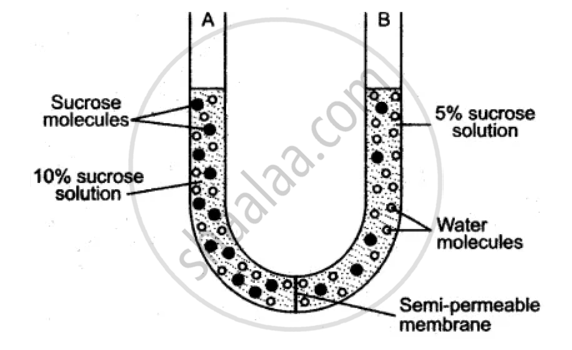
(i) What does the experiment demonstrate?
(ii) Define, the process demonstrated in the experiment.
(iii) What changes are observed after a few hours?
(iv) Give two examples of a semi-permeable membrane.
(v) Which limb of the U-tube contains a more concentrated sucrose solution, A or B?
(vi) Why is the membrane separating the two solutions labeled as semi-permeable membrane?
Concept: undefined >> undefined
A plant cell kept in a drop of water was examined under the low power magnification of a microscope, as shown:
(i) What would you do to bring this cell back to its original condition?
(ii) What scientific term is used for such condition?
(iii) Draw the same cell if it is kept in a strong sugar solution.
Concept: undefined >> undefined
The apparatus arranged here signifies an important process.
(i) Name the process.
(ii) Where does this process occur in plants?
(iii) What solution is placed inside the dialysis tubing?
(iv) What happens to the level of the solution in the capillary tube?
(v) Define the process mentioned in Q. (i) above.
Concept: undefined >> undefined
Given below is the figure of an experimental set up to demonstrate root pressure.
(i) Define root pressure.
(ii) What change would you observe in the water level after some time?
(iii) What role is being played by the root pressure in the given experiment?
(iv) Why the oil has been sprinkled on water?
Concept: undefined >> undefined
The diagram below represents an experimental set up to demonstrate a vital process. Study the same and then answer the questions that follow:
(i) Name the process.
(ii) Define the above named process.
(iii) What would you observe in the experimental setup after an hour or so?
(iv) What control experiment can be set up for the above experiment?
(v) Keeping in mind the root hair cell and its surrounding name the part that corresponds to (1) Concentrated sugar solution, (2) Parchment paper, (3) Water in the beaker.
(vi) Name any other substance that can be used instead of parchment paper in the above experiment.
(vii) Mention two advantages of this process to the plant.
Concept: undefined >> undefined
In an experiment, two sets of apparatus were set up as shown below:
In A there is a concentrated sugar solution inside the thistle funnel and red ink in the water outside the funnel. In B there is a concentrated glucose solution with red ink inside the thistle funnel and water outside the thistle funnel.
In both A and B the level of liquid inside the funnels rises up the tubes. In A the sugar solution turns red and in B, the water turns red.
Study the given observations and answer these questions:

- Name the process by which red ink moves in A and B.
- Which type of pressure forces the water molecules to move towards thistle funnels and cause a rise in the water level?
- Where does this process occur in plants and animals?
- What material could be used as a semi-permeable membrane?
Concept: undefined >> undefined
The beaker is divided into two chambers A and B. The big circle represents solute and the small circles solvent.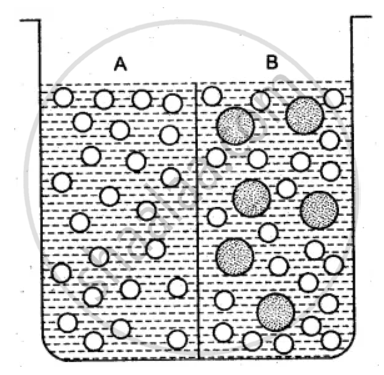
(i) What can you say about the size of the holes in the membrane, if it is to behave semi- permeably between these two?
(ii) Will the solvent molecules pass through the membrane from left to right, from right to left, in either direction or in both directions?
(iii) In which direction will there be a net movement of solvent molecules?
Concept: undefined >> undefined
Give Technical Term for the following.
Solutions which have the same osmotic pressure.
Concept: undefined >> undefined
Give Technical Term for the following.
A solution whose concentration is equal to the cell sap.
Concept: undefined >> undefined
