Please select a subject first
Advertisements
Advertisements
A coil has a self-inductance of 0·05 Henry. Find the magnitude of the emf induced in it when the current flowing through it is changing at the rate of 100 As-1.
Concept: undefined >> undefined
When an electric current is passed through a wire or a coil, a magnetic field is produced. Is the reverse phenomenon possible i.e, can a magnetic field produce an electric current? Explain with the help of an appropriate example.
Concept: undefined >> undefined
Advertisements
How will you convert a moving coil galvanometer into a voltmeter?
Concept: undefined >> undefined
Why are the pole pieces of a horseshoe magnet in a moving coil galvanometer made cylinder in shape?
Concept: undefined >> undefined
A moving coil galvanometer has a coil of resistance 59 Ω. It shows a full-scale deflection for a current of 50 mA. How will you convert it to an ammeter having a range of 0 to 3A?
Concept: undefined >> undefined
State how a moving coil galvanometer can be converted into an ammeter.
Concept: undefined >> undefined
A hollow sphere of radius R has a point charge Q at its centre. Electric flux emanating from it is `phi`. If both the charge and the radius of the sphere are doubled, electric flux emanating from the sphere will ______.
Concept: undefined >> undefined
A moving coil galvanometer of resistance 55 Ω produces a full scale deflection for a current of 250 mA. How will you convert it into an ammeter with a range of 0 - 3A?
Concept: undefined >> undefined
Assertion: When an electric current is passed through a moving coil galvanometer, its coil gets deflected.
Reason: A circular coil produces a uniform magnetic field around itself when an electric current is passed through it.
Concept: undefined >> undefined
A hollow sphere of radius R has a point charge q at its centre. Electric flux emanating from the sphere is X. How will the electric flux change, if at all, when radius of the sphere is doubled?
Concept: undefined >> undefined
A hollow sphere of radius R has a point charge q at its centre. Electric flux emanating from the sphere is X. How will the electric flux change, if at all, when charge q is replaced by an electric dipole?
Concept: undefined >> undefined
The figure below shows a circuit containing an ammeter A, a galvanometer G and a plug key K. When the key is closed:

Concept: undefined >> undefined
A galvanometer of resistance 100 Ω gives a full-scale deflection for a potential difference of 200 mV.
- What must be the resistance connected to convert the galvanometer into an ammeter of the range 0-200 mA?
- Determine resistance of the ammeter.
Concept: undefined >> undefined
A rectangular loop of area 5m2, has 50 turns and carries a current of 1A. It is hold in a uniform magnetic field of 0.1T, at an angle of 30°. Calculate the torque experienced by the coil.
Concept: undefined >> undefined
A closed surface in vacuum encloses charges –q and +3q. The total electric flux emerging out of the surface is :
Concept: undefined >> undefined
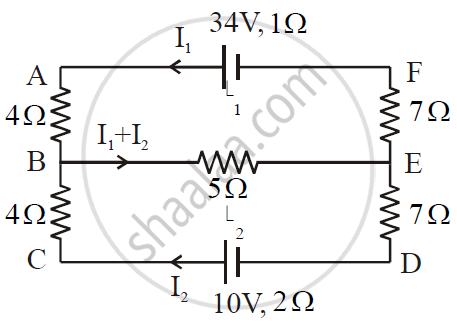
ε1 and ε2 are two batteries having emf of 34V and 10V respectively and internal resistance of 1Ω and 2Ω respectively. They are connected as shown in the figure below. Using Kirchhoff’s Laws of electrical networks, calculate the currents I1 and I2.
Concept: undefined >> undefined
On which conservation principle is Kirchoff's Second Law of electrical networks based?
Concept: undefined >> undefined
In the circuit shown in the figure below, E1 and E2 are two cells having emfs 2 V and 3 V respectively, and negligible internal resistance. Applying Kirchhoff’s laws of electrical networks, find the values of currents l1 and I2.

Concept: undefined >> undefined
In the circuit shown in Figure below, E1 and E2 are batteries having emfs of 25V and 26V. They have an internal resistance of 1 Ω and 5 Ω respectively. Applying Kirchhoff’s laws of electrical networks, calculate the currents I1 and I2.

Concept: undefined >> undefined
