Advertisements
Advertisements
How is a wavefront different from a ray?
Concept: undefined >> undefined
Explain the terms Attenuation used in Communication System.
Concept: undefined >> undefined
Advertisements
Write three characteristic features in photoelectric effect that cannot be explained on the basis of wave theory of light, but can be explained only using Einstein's equation.
Concept: undefined >> undefined
Sketch the graphs showing variation of stopping potential with frequency of incident radiations for two photosensitive materials A and B having threshold frequencies vA > vB.
(i) In which case is the stopping potential more and why?
(ii) Does the slope of the graph depend on the nature of the material used? Explain.
Concept: undefined >> undefined
Ram is a student of class X in a village school. His uncle gifted him a bicycle with a dynamo fitted in it. He was very excited to get it. While cycling during night, he could light the bulb and see the objects on the road. He, however, did not know how this device works. he asked this question to his teacher. The teacher considered it an opportunity to explain the working to the whole class.
Answer the following questions:
(a) State the principle and working of a dynamo.
(b) Write two values each displayed by Ram and his school teacher.
Concept: undefined >> undefined
Explain the terms : Transmitter in communication system
Concept: undefined >> undefined
Light of intensity ‘I’ and frequency ‘v’ is incident on a photosensitive surface and causes photoelectric emission. What will be the effect on anode current when (i) the intensity of light is gradually increased. In each case, all other factors remain the same. Explain, giving justification in each case.
Concept: undefined >> undefined
Light of intensity ‘I’ and frequency ‘v’ is incident on a photosensitive surface and causes photoelectric emission. What will be the effect on anode current when (ii) the frequency of incident radiation is increased. In each case, all other factors remain the same. Explain, giving justification in each case.
Concept: undefined >> undefined
Light of intensity ‘I’ and frequency ‘v’ is incident on a photosensitive surface and causes photoelectric emission. What will be the effect on anode current when the anode potential is increased? In each case, all other factors remain the same. Explain, giving justification in each case.
Concept: undefined >> undefined
A square loop MNOP of side 20 cm is placed horizontally in a uniform magnetic field acting vertically downwards as shown in the figure. The loop is pulled with a constant velocity of 20 cm s−1 till it goes out of the field.
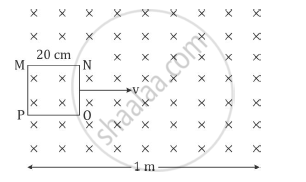
(i) Depict the direction of the induced current in the loop as it goes out of the field. For how long would the current in the loop persist?
(ii) Plot a graph showing the variation of magnetic flux and induced emf as a function of time.
Concept: undefined >> undefined
What is the function of a 'Repeater' used in communication system?
Concept: undefined >> undefined
Two monochromatic beams, one red and the other blue, have the same intensity. In which case (i) the number of photons per unit area per second is larger, (ii) the maximum kinetic energy of the photoelectrons is more? Justify your answer.
Concept: undefined >> undefined
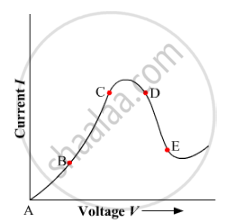
Graph showing the variation of current versus voltage for a material Ga As is shown in the figure. Identify the region of
(i) negative resistance
(ii) where Ohm's law is obeyed.
Concept: undefined >> undefined
Draw a plot showing the variation of photoelectric current versus the intensity of incident radiation on a given photosensitive surface.
Concept: undefined >> undefined
The current flowing through an inductor of self inductance L is continuously increasing. Plot a graph showing the variation of
Magnetic flux versus the current
Concept: undefined >> undefined
Draw a schematic sketch of an ac generator describing its basic elements. State briefly its working principle. Show a plot of variation of
(i) Magnetic flux and
(ii) Alternating emf versus time generated by a loop of wire rotating in a magnetic field.
Concept: undefined >> undefined
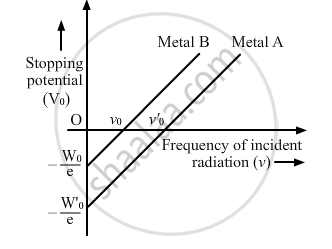
The graph shows the variation of stopping potential with frequency of incident radiation for two photosensitive metals A and B. Which one of the two has higher value of work-function? Justify your answer.
Concept: undefined >> undefined
Write the functions of the following in communication systems:
Transmitter
Concept: undefined >> undefined
Write the functions of the following in communication systems:
Modulator
Concept: undefined >> undefined
Write the functions of the following in communication systems:
Transducer
Concept: undefined >> undefined
