Advertisements
Advertisements
Question
Cutoff wavelength of X-rays coming from a Coolidge tube depends on the
(a) target material
(b) accelerating voltage
(c) separation between the target and the filament
(d) temperature of the filament.
Options
target material
accelerating voltage
separation between the target and the filament
temperature of the filament.
Advertisements
Solution
accelerating voltage
Cutoff wavelength (`lambda_min`) is given by `lambda_min = (hc)/(eV)`
Here,
h = Planck's constant
c = Speed of light
V = Accelerating voltage
e = Charge of electron
Clearly, a cutoff wavelength depends on accelerating voltage. It does not depend on the target material, separation between the target and the temperature of the filament.
APPEARS IN
RELATED QUESTIONS
(a) Give a list of at least five radiations, in order of their increasing frequencies, which make up the complete electromagnetic spectrum.
(b) Which of the radiation mentioned by you in part (a) has the highest penetrating power.
Name two electromagnetic waves of frequency smaller than that of violet light. State one use of each.
Can X-rays be used for photoelectric effect?
Can a hydrogen atom emit characteristic X-rays?
An X-ray beam can be deflected
An X-ray tube operates at 40 kV. Suppose the electron converts 70% of its energy into a photon at each collision. Find the lowest there wavelengths emitted from the tube. Neglect the energy imparted to the atom with which the electron collides.
(Use Planck constant h = 6.63 × 10⁻³⁴ Js= 4.14 × 10⁻¹⁵ eVs, speed of light c = 3 × 10⁸ m/s.)
Name the scientist who discovered Infra-red waves
Name the radiation which can be detected by thermopile.
Give one use of electromagnetic radiation in Microwaves.
What is the wavelength of the wave whose frequency is 1012 Hz? Name the electromagnetic wave.
Answer briefly.
Can we produce a pure electric or magnetic wave in space? Why?
For television broadcasting, the frequency employed is normally
The magnetic field of a beam emerging from a filter facing a floodlight is given by B0 = 12 × 10–8 sin (1.20 × 10⁷z – 3.60 × 10¹⁵t) T. What is the average intensity of the beam?
Electromagnetic waves of wavelengths λ1, λ2 and λ3 are used in a radar system, in water purifiers and in remote switches of TV, respectively.
- Identify the electromagnetic waves.
- Write one source for each of them.
The half-value thickness of an absorber is defined as the thickness that will reduce exponentially the intensity of a beam of particles by a factor of 2. The half-value thickness in (µm) for lead assuming X-ray beam of wavelength 20 pm, µ = 50 cm-1 for X-rays in lead at wavelength λ = 20 pm, is ______ µm.
Choose the correct option related to wavelengths (λ) of different parts of the electromagnetic spectrum.
What happens when an electron collides with a positron?
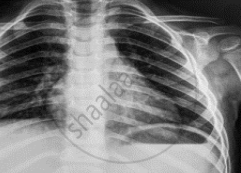
Name the electromagnetic radiation that has been used in obtaining the image below.
What is the wavelength range of electromagnetic radiation used in radio broadcast?
What gives rise to gamma rays?
