Please select a subject first
Advertisements
Advertisements
A myopic person has been using spectacles of power −1.0 dioptre for distant vision. During old age, he also needs to use the separate reading glass of power + 2.0 dioptres. Explain what may have happened.
Concept: undefined >> undefined
A person looking at a person wearing a shirt with a pattern comprising vertical and horizontal lines is able to see the vertical lines more distinctly than the horizontal ones. What is this defect due to? How is such a defect of vision corrected?
Concept: undefined >> undefined
Advertisements
What should be the distance between the object and the magnifying glass if the virtual image of each square in the figure is to have an area of 6.25 mm2. Would you be able to see the squares distinctly with your eyes very close to the magnifier?
Concept: undefined >> undefined
The angle subtended at the eye by an object is equal to the angle subtended at the eye by the virtual image produced by a magnifying glass. In what sense then does a magnifying glass provide angular magnification?
Concept: undefined >> undefined
In viewing through a magnifying glass, one usually positions one’s eyes very close to the lens. Does angular magnification change if the eye is moved back?
Concept: undefined >> undefined
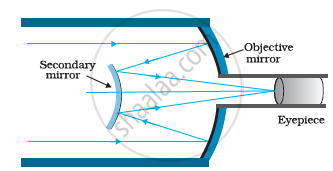
A Cassegrain telescope uses two mirrors as shown in the figure. Such a telescope is built with the mirrors 20 mm apart. If the radius of curvature of the large mirror is 220 mm and the small mirror is 140 mm, where will the final image of an object at infinity be?
Concept: undefined >> undefined
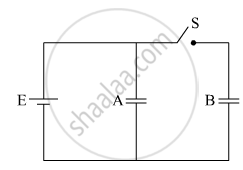
Two identical parallel plate capacitors A and B are connected to a battery of V volts with the switch S closed. The switch is now opened and the free space between the plates of the capacitors is filled with a dielectric of dielectric constant K. Find the ratio of the total electrostatic energy stored in both capacitors before and after the introduction of the dielectric.
Concept: undefined >> undefined
(i) Find equivalent capacitance between A and B in the combination given below. Each capacitor is of 2 µF capacitance.
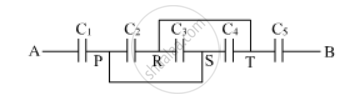
(ii) If a dc source of 7 V is connected across AB, how much charge is drawn from the source and what is the energy stored in the network?
Concept: undefined >> undefined
Why is it necessary to introduce a radial magnetic field inside the coil of a galvanometer?
Concept: undefined >> undefined
Can a galvanometer as such be used for measuring the current? Explain.
Concept: undefined >> undefined
Two identical capacitors of 12 pF each are connected in series across a battery of 50 V. How much electrostatic energy is stored in the combination? If these were connected in parallel across the same battery, how much energy will be stored in the combination now?
Also find the charge drawn from the battery in each case.
Concept: undefined >> undefined
With the help of a neat and labelled diagram, explain the principle and working of a moving coil galvanometer ?
Concept: undefined >> undefined
Define current sensitivity of a galvanometer.
Concept: undefined >> undefined
Why does a galvanometer when connected in series with a capacitor show a momentary deflection, when it is being charged or discharged?
How does this observation lead to modifying the Ampere's circuital law?
Hence write the generalised expression of Ampere's law.
Concept: undefined >> undefined
A capacitor of unknown capacitance is connected across a battery of V volts. The charge stored in it is 360 μC. When potential across the capacitor is reduced by 120 V, the charge stored in it becomes 120 μC.
Calculate:
(i) The potential V and the unknown capacitance C.
(ii) What will be the charge stored in the capacitor, if the voltage applied had increased by 120 V?
Concept: undefined >> undefined
A capacitor of unknown capacitance is connected across a battery of V volts. The charge stored in it is 300 μC. When potential across the capacitor is reduced by 100 V, the charge stored in it becomes 100 μC. Calculate The potential V and the unknown capacitance. What will be the charge stored in the capacitor if the voltage applied had increased by 100 V?
Concept: undefined >> undefined
Define the current sensitivity of a galvanometer ?
Concept: undefined >> undefined
Write current sensitivity of a galvanomete S.I. unit.
Concept: undefined >> undefined
Figure shows two circuits each having a galvanometer and a battery of 3V.
When the galvanometers in each arrangement do not show any deflection, obtain the ratio R1/R2.

Concept: undefined >> undefined
A capacitor of capacitance ‘C’ is being charged by connecting it across a dc source along with an ammeter. Will the ammeter show a momentary deflection during the process of charging? If so, how would you explain this momentary deflection and the resulting continuity of current in the circuit? Write the expression for the current inside the capacitor.
Concept: undefined >> undefined
