Please select a subject first
Advertisements
Advertisements
Explain, giving reasons, the basic difference in converting a galvanometer into (i) a voltmeter and (ii) an ammeter?
Concept: undefined >> undefined
Draw a labelled diagram of a moving coil galvanometer and explain its working. What is the function of radial magnetic field inside the coil?
Concept: undefined >> undefined
Advertisements
Draw the circuit for studying the input and output characteristics of and transistor in CE configuration. Show, how, from the output characteristics, the information about the current amplification factor (βac) can obtained.
Concept: undefined >> undefined
Draw a plot of the transfer characteristics (V0 versus Vi) for a base-biased transistor in CE configuration. Show for which regions in the plot, the transistor can operate as a switch ?
Concept: undefined >> undefined
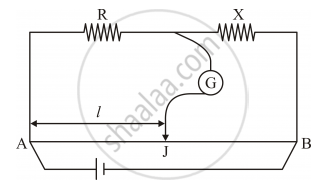
In the meter bridge experiment, balance point was observed at J with AJ = l.
(i) The values of R and X were doubled and then interchanged. What would be the new position of balance point?
(ii) If the galvanometer and battery are interchanged at the balance position, how will the alance point get affected?
Concept: undefined >> undefined
State the principle of the working of a moving coil galvanometer, giving its labeled diagram ?
Concept: undefined >> undefined
Outline the necessary steps to convert a galvanometer of resistance RG into an ammeter of a given range ?
Concept: undefined >> undefined
State the underlying principle of working of a moving coil galvanometer. Write two reasons why a galvanometer can not be used as such to measure current in a given circuit. Name any two factors on which the current sensitivity of a galvanometer depends.
Concept: undefined >> undefined
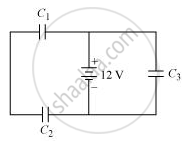
Three identical capacitors C1, C2 and C3 of capacitance 6 μF each are connected to a 12 V battery as shown.
Find
(i) charge on each capacitor
(ii) equivalent capacitance of the network
(iii) energy stored in the network of capacitors
Concept: undefined >> undefined
The muscles of a normal eye are least strained when the eye is focussed on an object
Concept: undefined >> undefined
When objects at different distances are seen by the eye, which of the following remain constant?
Concept: undefined >> undefined
A person A can clearly see objects between 25 cm and 200 cm. Which of the following may represent the range of clear vision for a person B having muscles stronger than A, but all other parameters of eye identical to that of A?
Concept: undefined >> undefined
The focal length of a normal eye-lens is about
Concept: undefined >> undefined
The distance of the eye-lens from the retina is x. For a normal eye, the maximum focal length of the eye-lens
Concept: undefined >> undefined
A man wearing glasses of focal length +1 m cannot clearly see beyond 1 m
Concept: undefined >> undefined
When we see an object, the image formed on the retina is
(a) real
(b) virtual
(c) erect
(d) inverted
Concept: undefined >> undefined
Mark the correct options.
(a) If the far point goes ahead, the power of the divergent lens should be reduced.
(b) If the near point goes ahead, the power of the convergent lens should be reduced.
(c) If the far point is 1 m away from the eye, divergent lens should be used.
(d) If the near point is 1 m away from the eye, divergent lens should be used.
Concept: undefined >> undefined
A person looks at different trees in an open space with the following details. Arrange the trees in decreasing order of their apparent sizes.
| Tree | Height(m) | Distance from the eye(m) |
| A | 2.0 | 50 |
| B | 2.5 | 80 |
| C | 1.8 | 70 |
| D | 2.8 | 100 |
Concept: undefined >> undefined
Can virtual image be formed on the retina in a seeing process?
Concept: undefined >> undefined
A normal eye has retina 2 cm behind the eye-lens. What is the power of the eye-lens when the eye is (a) fully relaxed, (b) most strained?
Concept: undefined >> undefined
