Advertisements
Advertisements
Question
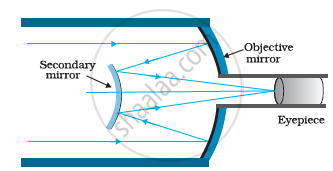
A Cassegrain telescope uses two mirrors as shown in the figure. Such a telescope is built with the mirrors 20 mm apart. If the radius of curvature of the large mirror is 220 mm and the small mirror is 140 mm, where will the final image of an object at infinity be?
Advertisements
Solution
A Cassegrain telescope consists of a concave mirror and a convex mirror.
Distance between the objective mirror and the secondary mirror, d = 20 mm
Radius of curvature of the objective mirror, R1 = 220 mm
Hence, focal length of the objective mirror, f1 = `"R"_1/2 = 220/2` = 110 mm
Radius of curvature of the secondary mirror, R2 = 140 mm
Hence, focal length of the secondary mirror, f2 = `"R"_2/2 = 140/2` = 70 mm
The image of an object placed at infinity, formed by the objective mirror, will act as a virtual object for the secondary mirror.
Hence, the virtual object distance for the secondary mirror, u = f1 − d
= 110 − 20
= 90 mm
Applying the mirror formula for the secondary mirror, we can calculate image distance (v) as:
`1/"v" + 1/"u" = 1/"f"_2`
`1/"v" = 1/"f"_2 - 1/"u"`
`1/"v" = 1/70 - 1/90`
`1/"v" = (90 - 70)/6300`
`1/"v" = 20/6300`
`1/"v" = 2/630`
v = `630/2`
∴ v = 315 mm
Hence, the final image will be formed 315 mm away from the secondary mirror.
