English

SSC (Marathi Semi-English) 10th Standard Board Exam [इयत्ता १० वी] - Maharashtra State Board Important Questions for Science and Technology 1

Advertisements
[object Object]
[object Object]
Subjects
Popular subjects
Topics
Advertisements
Advertisements
Science and Technology 1
< prev  241 to 260 of 629  next > 

Name and state the principle used to measure the specific heat capacity of a substance.

Appears in 1 question paper
Chapter: [5] Heat
Concept: Specific Heat Capacity

Read the following paragraph and answer the questions.
If heat is exchanged between a hot and cold object, the temperature of the cold object goes on increasing due to gain of energy and the temperature of the hot object goes on decreasing due to loss of energy.
The change in temperature continues till the temperatures of both the objects attain the same value. In this process, the cold object gains heat energy and the hot object loses heat energy. If the system of both the objects is isolated from the environment by keeping it inside a heat resistant box (meaning that the energy exchange takes place between the two objects only), then no energy can flow from inside the box or come into the box.


i. Heat is transferred from where to where?
ii. Which principle do we learn about from this process?
iii. How will you state the principle briefly?
iv. Which property of the substance is measured using this principle?

Appears in 1 question paper
Chapter: [5] Heat
Concept: Specific Heat Capacity

Study the following procedure and answer the questions below:
1. Take 3 spheres of iron, copper and lead of equal mass.
2. Put all the 3 spheres in boiling water in a beaker for some time.
3. Take 3 spheres out of the water. Put them immediately on a thick slab of wax.
4. Note, the depth that each sphere goes into the wax.
i) Which property of substance can be studied with this procedure?
ii) Describe that property in minimum words.
iii) Explain the rule of heat exchange with this property.

Appears in 1 question paper
Chapter: [5] Heat
Concept: Specific Heat Capacity

When heat energy is absorbed by object ΔT represents the raise in temperature. What would be ΔT represent if the object loses heat energy?

Appears in 1 question paper
Chapter: [5] Heat
Concept: Measurement of Specific Heat: (Mixing Method) and Calorimeter

The vapour content in the air is measured using a physical quantity called ____________.

Appears in 1 question paper
Chapter: [5] Heat
Concept: Dew Point and Humidity

Write a short note.

Specific heat capacity

Appears in 1 question paper
Chapter: [5] Heat
Concept: Specific Heat Capacity

How much is the relative humidity at the dew point?

Appears in 1 question paper
Chapter: [5] Heat
Concept: Dew Point and Humidity

To study energy exchange between hot and cold objects, the system of both objects is isolated from the environment by keeping them inside ______.

Appears in 1 question paper
Chapter: [5] Heat
Concept: Specific Heat Capacity

Match the columns:

Column ‘A’ Column ‘B’
The SI unit of specific heat capacity (a) Jkg−1°C−1
(b) kg/m3
(c) calorie
Appears in 1 question paper
Chapter: [5] Heat
Concept: Specific Heat Capacity

Find the odd one out:

Appears in 1 question paper
Chapter: [5] Heat
Concept: Specific Heat Capacity

How do we feel about air in each of the following conditions?

  1. Relative humidity is more than 60%.
  2. Relative humidity is less than 60%.
Appears in 1 question paper
Chapter: [5] Heat
Concept: Dew Point and Humidity

Observe the following diagram and answer the questions given below:


       Specific heat capacity of metals

  1. Which element has maximum specific heat capacity? Justify.
  2. Which element has minimum specific heat capacity? Justify.
  3. Define specific heat of object.
Appears in 1 question paper
Chapter: [5] Heat
Concept: Specific Heat Capacity

Write the use of ‘Calorimeter’.

Appears in 1 question paper
Chapter: [5] Heat
Concept: Measurement of Specific Heat: (Mixing Method) and Calorimeter
  Column I Column II Column III
1 Dispersion Long-sightedness Twinkling of stars
2 Refraction Splitting of white light into component colours Convex lens
3 Hypermetropia Change in the direction of the ray of light due to change in medium Spectrum of seven colours
Appears in 1 question paper
Chapter: [6] Refraction of Light
Concept: Refraction of Light

Choose and write the correct option.

If we gradually increase the angle of incidence of a ray of light passing through prism then …..

Appears in 1 question paper
Chapter: [6] Refraction of Light
Concept: Refraction of Light

The phenomenon of splitting of light into its component colours is ___________ .

Appears in 1 question paper
Chapter: [6] Refraction of Light
Concept: Dispersion of Light

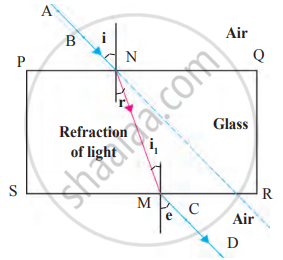
The phenomenon of change in the direction of light when it passes from one transparent medium to another is called ___________.

Appears in 1 question paper
Chapter: [6] Refraction of Light
Concept: Refraction of Light

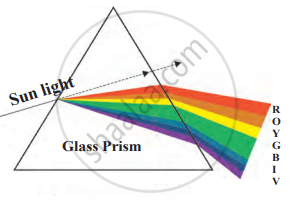
Draw a labelled diagram: Dispersion of light through a prism.

Appears in 1 question paper
Chapter: [6] Refraction of Light
Concept: Dispersion of Light

Answer the following:

What do you mean by dispersion? Name the different colours of light in the proper sequence in the spectrum of light. 

Appears in 1 question paper
Chapter: [6] Refraction of Light
Concept: Dispersion of Light

Explain how the formation of a rainbow occurs.

Appears in 1 question paper
Chapter: [6] Refraction of Light
Concept: Refraction of Light
< prev  241 to 260 of 629  next > 
Advertisements
Advertisements
Maharashtra State Board SSC (Marathi Semi-English) 10th Standard Board Exam [इयत्ता १० वी] Important Questions
Important Questions for Maharashtra State Board SSC (Marathi Semi-English) 10th Standard Board Exam [इयत्ता १० वी] Algebra
Important Questions for Maharashtra State Board SSC (Marathi Semi-English) 10th Standard Board Exam [इयत्ता १० वी] English (Second/Third Language)
Important Questions for Maharashtra State Board SSC (Marathi Semi-English) 10th Standard Board Exam [इयत्ता १० वी] Geography [भूगोल]
Important Questions for Maharashtra State Board SSC (Marathi Semi-English) 10th Standard Board Exam [इयत्ता १० वी] Geometry Mathematics 2
Important Questions for Maharashtra State Board SSC (Marathi Semi-English) 10th Standard Board Exam [इयत्ता १० वी] Hindi (Second/Third Language) [हिंदी (दूसरी/तीसरी भाषा)]
Important Questions for Maharashtra State Board SSC (Marathi Semi-English) 10th Standard Board Exam [इयत्ता १० वी] Hindi - Composite [हिंदी - संयुक्त]
Important Questions for Maharashtra State Board SSC (Marathi Semi-English) 10th Standard Board Exam [इयत्ता १० वी] History and Political Science [इतिहास व राज्यशास्त्र]
Important Questions for Maharashtra State Board SSC (Marathi Semi-English) 10th Standard Board Exam [इयत्ता १० वी] Marathi [मराठी]
Important Questions for Maharashtra State Board SSC (Marathi Semi-English) 10th Standard Board Exam [इयत्ता १० वी] Sanskrit (Second Language) [संस्कृत (द्वितीय भाषा)]
Important Questions for Maharashtra State Board SSC (Marathi Semi-English) 10th Standard Board Exam [इयत्ता १० वी] Sanskrit - Composite [संस्कृत - संयुक्त (द्वितीय भाषा)]
Important Questions for Maharashtra State Board SSC (Marathi Semi-English) 10th Standard Board Exam [इयत्ता १० वी] Science and Technology 1
Important Questions for Maharashtra State Board SSC (Marathi Semi-English) 10th Standard Board Exam [इयत्ता १० वी] Science and Technology 2
Share
Notifications

Englishहिंदीमराठी


      Forgot password?
Use app×