Please select a subject first
Advertisements
Advertisements
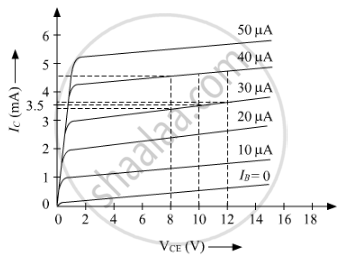
Output characteristics of an n-p-n transistor in CE configuration is shown in the figure.
Determine:
(i) dynamic output resistance
(ii) dc current gain and
(iii) ac current gain at an operating point VCE = 10 V, when IB = 30 μA.
Concept: Representation of AC Current and Voltage by Rotating Vectors - Phasors
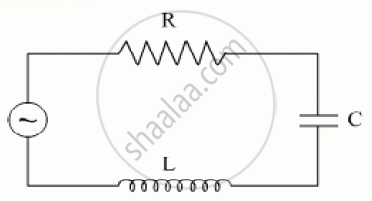
The figure shows a series LCR circuit with L = 10.0 H, C = 40 μF, R = 60 Ω connected to a variable frequency 240 V source, calculate
(i) the angular frequency of the source which drives the circuit at resonance,
(ii) the current at the resonating frequency,
(iii) the rms potential drop across the inductor at resonance.
Concept: AC Voltage Applied to a Series LCR Circuit
An alternative voltage given by V = 140 sin 314t is connected across a pure resistor of 50 Ω. Find
- The frequency of the source.
- The rms current is through the resistor.
Concept: AC Voltage Applied to a Resistor
Name the parts of the electromagnetic spectrum which is
used to treat muscular strain.
Write in brief, how these waves can be produced.
Concept: Electromagnetic Spectrum
Name the parts of the electromagnetic spectrum which is
used as a diagnostic tool in medicine.
Write in brief, how these waves can be produced.
Concept: Electromagnetic Spectrum
A capacitor has been charged by a dc source. What are the magnitude of conduction and displacement current, when it is fully charged?
Concept: Displacement Current
Name of physical quantity which remains same for microwaves of wavelength 1 mm and UV radiations of 1600 Å in vacuum.
Concept: Electromagnetic Spectrum
When an ideal capacitor is charged by a dc battery, no current flows. However, when an ac source is used, the current flows continuously. How does one explain this, based on the concept of displacement current?
Concept: Displacement Current
Answer briefly.
Give two uses of radio waves.
Concept: Electromagnetic Spectrum
Arrange the following electromagnetic radiation in the ascending order of their frequencies:
X-rays, microwaves, gamma rays, radio waves
Concept: Electromagnetic Spectrum
Write two uses of the following radiation.
Gamma rays
Concept: Electromagnetic Spectrum
State the condition under which a large magnification can be achieved in an astronomical telescope.
Concept: Introduction to Optical Instruments >> Telescope
Write the necessary conditions for the phenomenon of total internal reflection to
occur ?
Concept: Total Internal Reflection
Write the relation between the refractive index and critical angle for a given pair of optical media?
Concept: Total Internal Reflection
One day Chetan’s mother developed a severe stomach ache all of a sudden. She was rushed to the doctor who suggested for an immediate endoscopy test and gave an estimate of expenditure for the same. Chetan immediately contacted his class teacher and shared the information with her. The class teacher arranged for the money and rushed to the hospital. On realizing that Chetan belonged to a below average income group family, even the doctor offered concession for the test fee. The test was conducted successfully.
Answer the following questions based on the above information:
(a) Which principle in optics is made use of in endoscopy?
(b) Briefly explain the values reflected in the action taken by the teacher.
(c) In what way do you appreciate the response of the doctor on the given situation?
Concept: Total Internal Reflection
Define magnifying power of a telescope. Write its expression.
Concept: Introduction to Optical Instruments >> Telescope
A small telescope has an objective lens of focal length 150 cm and an eye piece of focal length 5 cm. If this telescope is used to view a 100 m high tower 3 km away, find the height of the final image when it is formed 25 cm away from the eye piece.
Concept: Introduction to Optical Instruments >> Telescope
How is the working of a telescope different from that of a microscope?
Concept: Introduction to Optical Instruments >> Telescope
The focal lengths of the objective and eyepiece of a microscope are 1.25 cm and 5 cm respectively. Find the position of the object relative to the objective in order to obtain an angular magnification of 30 in normal adjustment.
Concept: Introduction to Optical Instruments >> Telescope
A ray of light passes through a prism of refractive index `sqrt2` as shown in the figure. Find:
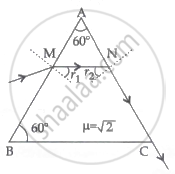
- The angle of incidence (∠r2) at face AC.
- The angle of minimum deviation for this prism.
Concept: Total Internal Reflection
