Please select a subject first
Advertisements
Advertisements
An element with density 11.2 g cm–3 forms a f.c.c. lattice with edge length of 4 × 10⁻⁸ cm.
Calculate the atomic mass of the element.
(Given : NA = 6.022 × 10²³ mol–1)
Concept: Calculations Involving Unit Cell Dimensions
Examine the given defective crystal:
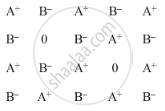
Answer the following questions :
(i) What type of stoichiometric defect is shown by the crystal?
(ii) How is the density of the crystal affected by this defect?
(iii) What type of ionic substances show such defect?
Concept: Imperfections in Solids >> Types of Point Defects - Stoichiometric Defects
Calculate the mass of a compound (molar mass = 256 g mol−1) to be dissolved in 75 g of benzene to lower its freezing point by 0.48 K (Kf = 5.12 K kg mol−1).
Concept: Colligative Properties and Determination of Molar Mass >> Osmosis and Osmotic Pressure
An unripe mango placed in a concentrated salt solution to prepare pickle, shrivels because ______.
Concept: Colligative Properties and Determination of Molar Mass >> Reverse Osmosis and Water Purification
When 19.5 g of F – CH2 – COOH (Molar mass = 78 g mol−1), is dissolved in 500 g of water, the depression in freezing point is observed to be 1°C. Calculate the degree of dissociation of F – CH2 – COOH.
[Given: Kf for water = 1.86 K kg mol−1]
Concept: Abnormal Molar Masses
Why is the value of van't Hoff factor for ethanoic acid in benzene close to 0.5?
Concept: Abnormal Molar Masses
Why is boiling point of 1 M NaCl solution more than that of 1 M glucose solution?
Concept: Abnormal Molar Masses
A non-volatile solute 'X' (molar mass = 50 g mol−1), when dissolved in 78 g of benzene, reduced its vapour pressure to 90%. Calculate the Mass of X dissolved in the solution.
Concept: Colligative Properties and Determination of Molar Mass >> Relative Lowering of Vapour Pressure
Calculate the boiling point elevation for a solution prepared by adding 10 g of MgCl2 to 200 g of water, assuming MgCl2 is completely dissociated.
(Kb for Water = 0.512 K kg mol−1, Molar mass MgCl2 = 95 g mol−1)
Concept: Colligative Properties and Determination of Molar Mass >> Elevation of Boiling Point
Determine the osmotic pressure of a solution prepared by dissolving 2.32 × 10⁻² g of K2SO4 in 2L of solution at 25°C assuming that K2SO4 is completely dissociated.
(R = 0.082 L atm K−1 mol, Molar mass K2SO4 = 174 g mol−1)
Concept: Colligative Properties and Determination of Molar Mass >> Osmosis and Osmotic Pressure
When 25.6 g of sulphur was dissolved in 1000 g of benzene, the freezing point lowered by 0.512 K. Calculate the formula of sulphur (Sr).
(Kf for benzene = 5.12 K kg mol−1, Atomic mass of sulphur = 32 g mol−1)
Concept: Colligative Properties and Determination of Molar Mass >> Depression of Freezing Point
From the given cells:
Lead storage cell, Mercury cell, Fuel cell and Dry cell
Answer the following:
(i) Which cell is used in hearing aids?
(ii) Which cell was used in Apollo Space Programme?
(iii) Which cell is used in automobiles and inverters?
(iv) Which cell does not have long life?
Concept: Batteries >> Primary Batteries
Why conductivity of an electrolyte solution decreases with the decrease in concentration ?
Concept: Conductance of Electrolytic Solutions >> Variation of Conductivity and Molar Conductivity with Concentration
Calculate the mass of Ag deposited at cathode when a current of 2 amperes was passed through a solution of AgNO3 for 15 minutes.
(Given : Molar mass of Ag = 108 g mol−1 lF = 96500 C mol−1)
Concept: Electrolytic Cells and Electrolysis
Define the following terms :
Limiting molar conductivity
Concept: Conductance of Electrolytic Solutions >> Variation of Conductivity and Molar Conductivity with Concentration
Read the passage given below and answer the questions that follow:
|
Oxidation-reduction reactions are commonly known as redox reactions. They involve transfer of electrons from one species to another. In a spontaneous reaction, energy is released which can be used to do useful work. The reaction is split into two half-reactions. Two different containers are used and a wire is used to drive the electrons from one side to the other and a Voltaic/Galvanic cell is created. It is an electrochemical cell that uses spontaneous redox reactions to generate electricity. A salt bridge also connects to the half-cells. The reading of the voltmeter gives the cell voltage or cell potential or electromotive force. If \[\ce{E^0_{cell}}\] is positive the reaction is spontaneous and if it is negative the reaction is non-spontaneous and is referred to as electrolytic cell. Electrolysis refers to the decomposition of a substance by an electric current. One mole of electric charge when passed through a cell will discharge half a mole of a divalent metal ion such as Cu2+. This was first formulated by Faraday in the form of laws of electrolysis.
|

- Is silver plate the anode or cathode? (1)
- What will happen if the salt bridge is removed? (1)
- When does electrochemical cell behaves like an electrolytic cell? (1)
- (i) What will happen to the concentration of Zn2+ and Ag+ when Ecell = 0. (1)
(ii) Why does conductivity of a solution decreases with dilution? (1)
OR
The molar conductivity of a 1.5 M solution of an electrolyte is found to be 138.9 S cm2mol-1. Calculate the conductivity of this solution. (2)
Concept: Electrochemical Cells
Conductivity of 2 × 10⁻³ M methanoic acid is 8 × 10⁻⁵ S cm−1. Calculate its molar conductivity and degree of dissociation if `∧_"m"^0` for methanoic acid, is 404 S cm2 mol−3.
Concept: Conductance of Electrolytic Solutions >> Variation of Conductivity and Molar Conductivity with Concentration
Calculate the ΔrG0 and log Kc, for the given reaction at 298 K:
\[\ce{Ni_{(s)} + 2Ag^+_{( aq)} <=> Ni^{2+}_{( aq)} + 2Ag_{(s)}}\]
Given: `"E"_("Ni"^(2+)//"Ni")^0` = −0.25 V, `"E"_("Ag"^+//"Ag")^0` = +0.80 V, 1F = 96500 C mol−1.
Concept: Nernst Equation >> Electrochemical Cell and Gibbs Energy of the Reaction
Four half-reactions, I to IV are shown below:
- \[\ce{2Cl^- -> Cl2 + 2e^-}\]
- \[\ce{4OH^- -> O2 + 2H2O + 2e^-}\]
- \[\ce{Na^+ + e^- -> Na}\]
- \[\ce{2H^+ + 2e^- -> H2}\]
Which two of these reactions are most likely to occur when concentrated brine is electrolysed?
Concept: Electrolytic Cells and Electrolysis >> Products of Electrolysis
What should be the signs (positive/negative) for \[\ce{E^0_{cell}}\] and ΔG0 for a spontaneous redox reaction occurring under standard conditions?
Concept: Electrochemical Cells
