Advertisements
Advertisements
Question
Conductivity of 2 × 10⁻³ M methanoic acid is 8 × 10⁻⁵ S cm−1. Calculate its molar conductivity and degree of dissociation if `∧_"m"^0` for methanoic acid, is 404 S cm2 mol−3.
Advertisements
Solution
Given: Conductivity (K) = 8 × 10⁻⁵ S cm−1
Molarity (M) = 2 × 10⁻³ M
Formula:
Molar conductivity, `∧_"m"^"c" = ("K" xx 1000)/"C"`
Degree of dissociation, α = `∧_"m"^"c"/∧_"m"^0`
`∧_"m"^0 = ("K" xx 1000)/"C"` S cm2 mol−1
= `(8 xx 10^-5 xx 1000)/(2 xx 10^-3)`
= 40 S cm2 mol−1
`∝` = `(∧_"m"^"c")/(∧_"m"^0)`
= `40/404`
= 0.1
APPEARS IN
RELATED QUESTIONS
Why does the conductivity of a solution decrease with dilution?
The conductivity of 0.02 M AgNO3 at 25°C is 2.428 × 10⁻³ Ω−1 cm−1. What is its molar conductivity?
In the plot of molar conductivity (∧m) vs square root of concentration (c1/2) following curves are obtained for two electrolytes A and B : 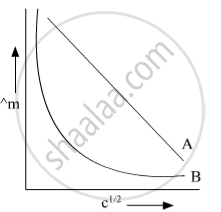
Answer the following:
(i) predict the nature of electrolytes A and B.
(ii) What happens on the extrapolation of ∧m to concentration approaching for electrolytes A and B?
Solutions of two electrolytes ‘A’ and ‘B’ are diluted. The Λm of ‘B’ increases 1.5 times while that of A increases 25 times. Which of the two is a strong electrolyte? Justify your answer.
Given below are two statements:
Statements I: The limiting molar conductivity of KCl (strong electrolyte) is higher compared to that of CH3COOH (weak electrolyte).
Statement II: Molar conductivity decreases with decrease in concentration of electrolyte.
In the light of the above statements, choose the most appropriate answer from the options given below:
The solubility of Co2[Fe(CN)6] in water at 25°C from the following data:
Conductivity of saturated solution of Co2[Fe(CN)6] = 2.06 × 10⁻⁶ ohm−1 cm−1 and that of water = 4.1 × 10⁻⁷ ohm−1 cm−1. The ionic molar conductivities of Co2+ and [Fe(CN)6]4− are 86 and 444 ohm−1 cm2 mol−1 respectively, is ______ × 10−6 mol/L.
Which of the following solutions of KCl will have the highest value of molar conductivity?
Assertion (A): Molar conductivity decreases with increase in concentration.
Reason (R): When concentration approaches zero, the molar conductivity is known as limiting molar conductivity.
The specific conductance of 2.5 × 10⁻⁴ M formic acid is 5.25 × 10⁻⁵ ohm-1 cm-1. Calculate its molar conductivity and degree of dissociation.
Given `λ°_("H"^+)` = 349.5 ohm-1 cm2 mol-1 and
`λ°_("HCOO"^-) = 50.5 " ohm"^-1 "cm"^2 "mol"^-1`
The solution of two electrolytes A and B are diluted. ^m of B increases 1.5 times while that of A increases 25 times. Which of the two is a strong electrolyte? Give a reason.
