Advertisements
Advertisements
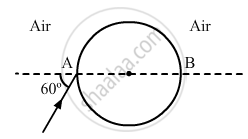
A ray of light falls on a transparent sphere with centre C as shown in the figure. The ray emerges from the sphere parallel to the line AB. Find the angle of refraction at A if the refractive index of the material of the sphere is \[\sqrt{3}\].
Concept: The Parallel Plate Capacitor
In a parallel plate capacitor with air between the plates, each plate has an area of 6 × 10⁻³m2 and the separation between the plates is 3 mm.
- Calculate the capacitance of the capacitor.
- If this capacitor is connected to 100 V supply, what would be the charge on each plate?
- How would charge on the plates be affected, if a 3 mm thick mica sheet of k = 6 is inserted between the plates while the voltage supply remains connected?
Concept: The Parallel Plate Capacitor
A capacitor of unknown capacitance is connected across a battery of V volts. The charge stored in it is 360 μC. When potential across the capacitor is reduced by 120 V, the charge stored in it becomes 120 μC.
Calculate:
(i) The potential V and the unknown capacitance C.
(ii) What will be the charge stored in the capacitor, if the voltage applied had increased by 120 V?
Concept: Capacitors and Capacitance
An electric dipole is held in a uniform electric field.
(i) Show that the net force acting on it is zero.
(ii) The dipole is aligned parallel to the field. Find the work done in rotating it through the angle of 180°.
Concept: Potential Due to an Electric Dipole
A capacitor of capacitance ‘C’ is being charged by connecting it across a dc source along with an ammeter. Will the ammeter show a momentary deflection during the process of charging? If so, how would you explain this momentary deflection and the resulting continuity of current in the circuit? Write the expression for the current inside the capacitor.
Concept: Capacitors and Capacitance
Deduce the expression for the electrostatic energy stored in a capacitor of capacitance 'C' and having charge 'Q'.
Concept: Equipotential Surfaces >> Relation Between Electric Field and Electrostatic Potential
How will the (i) energy stored and (ii) the electric field inside the capacitor be affected when it is completely filled with a dielectric material of dielectric constant K?
Concept: Equipotential Surfaces >> Relation Between Electric Field and Electrostatic Potential
Answer the following question.
Describe briefly the process of transferring the charge between the two plates of a parallel plate capacitor when connected to a battery. Derive an expression for the energy stored in a capacitor.
Concept: The Parallel Plate Capacitor
Solve the following question.
A parallel plate capacitor is charged by a battery to a potential difference V. It is disconnected from the battery and then connected to another uncharged capacitor of the same capacitance. Calculate the ratio of the energy stored in the combination to the initial energy on the single capacitor.
Concept: The Parallel Plate Capacitor
Two identical point charges, q each, are kept 2m apart in the air. A third point charge Q of unknown magnitude and sign is placed on the line joining the charges such that the system remains in equilibrium. Find the position and nature of Q.
Concept: Equipotential Surfaces
A point charge is placed at the centre of a hollow conducting sphere of internal radius ‘r’ and outer radius ‘2r’. The ratio of the surface charge density of the inner surface to that of the outer surface will be ______.
Concept: Electrostatics of Conductors
Obtain the expression for the energy stored in a capacitor connected across a dc battery.
Concept: Energy Stored in a Charged Capacitor
Two-point charges q1 and q2 are kept at a distance of r12 in air. Deduce the expression for the electrostatic potential energy of this system.
Concept: Equipotential Surfaces >> Relation Between Electric Field and Electrostatic Potential
If an external electric field (E) is applied on the system, write the expression for the total energy of this system.
Concept: Equipotential Surfaces >> Relation Between Electric Field and Electrostatic Potential
The variation of inductive reactance (XL) of an inductor with the frequency (f) of the ac source of 100 V and variable frequency is shown in fig.
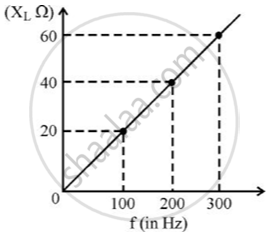
- Calculate the self-inductance of the inductor.
- When this inductor is used in series with a capacitor of unknown value and a resistor of 10 Ω at 300 s–1, maximum power dissipation occurs in the circuit. Calculate the capacitance of the capacitor.
Concept: Capacitors and Capacitance
Two cells of emfs 1.5 V and 2.0 V, having internal resistances 0.2 Ω and 0.3 Ω, respectively, are connected in parallel. Calculate the emf and internal resistance of the equivalent cell.
Concept: Cells, EMF, and Internal Resistance
Define the term drift velocity.
Concept: Drift of Electrons and the Origin of Resistivity
Write its (‘mobility’ of charge carriers) S.I. unit
Concept: Drift of Electrons and the Origin of Resistivity
A low voltage supply from which one needs high currents must have very low internal resistance. Why?
Concept: Ohm's Law
Nichrome and copper wires of same length and same radius are connected in series. Current I is passed through them. Which wire gets heated up more? Justify your answer.
Concept: Cells, EMF, and Internal Resistance
