Advertisements
Advertisements
Question
How will the (i) energy stored and (ii) the electric field inside the capacitor be affected when it is completely filled with a dielectric material of dielectric constant K?
Advertisements
Solution
When an additional amount of charge dq is transferred from negative to positive plate, the small work done is given by `dw =Vdq =q/Cdq`
The total work done in transferring total charge Q is given by
`w=int_0^Q q/c dq = 1/Cint_0^Q qdq = 1/c[q^2/2]_0^Q = 1/C [Q^2/2 -0]`
=`Q^2/(2C)`
This work is stored as electrostatic potential energy U in the capacitor.
z`U =Q^2/(2C)`
`or U =((CV)^2)/(2C) [because Q = CV]`
`or U =1/2 CV^2`
`or U =1/2QV`
When dielectric material of dielectric constant ‘k’ is introduced inside the capacitor then
(ii) Electric field is reduced
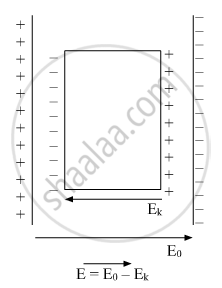
`(E_0)/E =k`
`\text {But} k>1 so E_0/E>1 or E_0>E`
When dielectric is introduced in capacitor opposite charge is induced on the plates of dielectric as a result of which an electric field is induced which is in opposite direction. Thus, Net electric field is reduced.
(i) Again, V0 = E0d ... (1)
Where V0 is the potential when there is vacuum between the plates of the capacitor and d is the separation between the plates of the capacitor,
When dielectric is introduced, potential difference is given by
V = Ed ... (2)
Dividing (1) & (2)
`V_0/V = E_0/E =k`
But k > 1 ∴ V0 > V
Thus potential difference also decreases.
We have energy stored as z``U=1/2 QV`Since V decreases, U also decreases.
RELATED QUESTIONS
A long charged cylinder of linear charged density λ is surrounded by a hollow co-axial conducting cylinder. What is the electric field in the space between the two cylinders?
Why is electrostatic potential constant throughout the volume of the conductor and has the same value (as inside) on its surface?
A hollow metal sphere of radius 10 cm is charged such that the potential on its surface is 5 V. What is the potential at the centre of the sphere?
A capacitor having a capacitance of 100 µF is charged to a potential difference of 24 V. The charging battery is disconnected and the capacitor is connected to another battery of emf 12 V with the positive plate of the capacitor joined with the positive terminal of the battery. (a) Find the charges on the capacitor before and after the reconnection. (b) Find the charge flown through the 12 V battery. (c) Is work done by the battery or is it done on the battery? Find its magnitude. (d) Find the decrease in electrostatic field energy. (e) Find the heat developed during the flow of charge after reconnection.
Two-point charges q1 and q2 are kept at a distance of r12 in air. Deduce the expression for the electrostatic potential energy of this system.
If an external electric field (E) is applied on the system, write the expression for the total energy of this system.
What is the differential relationship between the magnitude of the electric field \[|E|\] and the potential gradient along the normal displacement \[dl\]?
Regarding the direction of the electric field vector, which statement is strictly correct?
How is the magnitude of the electric field \[E\] defined with respect to an equipotential surface?
How does a smartphone touchscreen detect the location of a finger based on electrostatic principles?
