Please select a subject first
Advertisements
Advertisements
How is Hardy-Weinberg’s expression “(p2 + 2pq + q2) = 1” derived?
Concept: Hardy Weinberg’s Principle
List any two factors that can disturb the genetic equilibrium.
Concept: Hardy Weinberg’s Principle
Write the scientific name of the source plant and the part from which opiods are extracted. What is it commonly and chemically called?
Concept: Categories of Drugs >> Effects of Drug and Alcohol Abuse
What are methanogens?
Concept: Microbes in Production of Biogas
Describe how do 'flocs' and 'activated sludge' help in Sewage Treatment.
Concept: Microbes in Sewage Treatment
Why are baculoviruses considered good biocontrol agents?
Concept: Microbes as Biocontrol Agents
Suggest two advantages to a farmer for using apomictic seeds of hybrid varieties.
Concept: Strategies for Enhancement in Food Production (Questions)
Explain, giving three reasons, why tropics show greatest levels of species diversity.
Concept: Patterns of Biodiversity
An element has atomic mass 93 g mol−1 and density 11.5 g cm–3. If the edge length of its unit cell is 300 pm, identify the type of unit cell. (NA = 6.023 × 10²³ mol−1)
Concept: Number of Atoms in a Unit Cell
Calculate the number of unit cells in 8.1 g of aluminium if it crystallizes in a f.c.c. structure. (Atomic mass of Al = 27 g mol–1)
Concept: Number of Atoms in a Unit Cell
Give reasons:Ferrimagnetic substances show better magnetism than antiferromagnetic substances.
Concept: Properties of Solids: Magnetic Properties
Why are aquatic species more comfortable in cold water in comparison to warm water?
Concept: Colligative Properties and Determination of Molar Mass >> Reverse Osmosis and Water Purification
Calculate the degree of dissociation (α) of acetic acid if its molar conductivity (Λm) is 39.05 S cm2 mol−1.
(Given \[\ce{\lambda^{\circ}_{(H^+)}}\] = 349.6 S cm2 mol−1 and \[\ce{\lambda^{\circ}_{(CH_3COO^-)}}\] = 40.95 S cm2 mol−1)
Concept: Conductance of Electrolytic Solutions >> Variation of Conductivity and Molar Conductivity with Concentration
Account for the following:
E° value for the Mn3+/Mn2+ couple is highly positive (+1.57 V) as compare to Cr3+/Cr2+.
Concept: Galvanic Cells - Measurement of Electrode Potential
Which of the following cell was used in the Apollo space programme?
Concept: Fuel Cells
For a reaction A + B ⟶ P, the rate is given by
Rate = k [A] [B]2
How is the rate of reaction affected if the concentration of B is doubled?
Concept: Factors Influencing Rate of a Reaction
For a reaction A + B ⟶ P, the rate is given by
Rate = k [A] [B]2
What is the overall order of reaction if A is present in large excess?
Concept: Factors Influencing Rate of a Reaction
For a chemical reaction R → P, the variation in the concentration (R) vs. time (t) plot is given as:
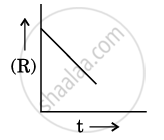
(i) Predict the order of the reaction.
(ii) What is the slope of the curve?
(iii) Write the unit of rate constant for this reaction.
Concept: Factors Influencing Rate of a Reaction
A first-order reaction is 50% complete in 30 minutes at 300 K and in 10 minutes at 320 K. Calculate activation energy (Ea) for the reaction. [R = 8.314 J K−1 mol−1]
[Given: log 2 = 0.3010, log 3 = 0.4771, log 4 = 0.6021]
Concept: Temperature Dependence of the Rate of a Reaction
