Science (English Medium)
Academic Year: 2019-2020
Date & Time: 14th March 2020, 10:30 am
Duration: 3h
Advertisements
General Instructions:
Read the following instructions very carefully and strictly follow them:
- Question paper comprises five sections: A, B, C, D and E.
- There are 27 questions in the question paper. All questions are compulsory.
- Section A question number 1 to 5 are multiple choice questions carrying 1 mark each.
- Section B question number 6 to 12 are short answer questions type-I, carrying 2 marks each.
- Section C contains number 13 to 21 are short answer questions type-II carrying 3 marks each.
- Section D contains number 22 to 24 are short answer questions type-III, carrying 3 marks each.
- Section E question number 25 to 27 are long answer questions, carrying 5 marks each.
- Answer should be brief and to the point also the above word limit be adhered to as far as possible.
- There is no overall choice in the question paper. However, an internal choice has been provided in two questions of 1 mark, one question of 2 marks, two questions of 3 marks and three questions of 5 marks questions. Only one of the choices in such questions have to be attempted.
- The diagram drawn should be neat proportionate and properly labelled, wherever necessary.
- In addition to this, separate instructions are given in each section and question, wherever necessary.
Which one of the following part of the plant when put into the soil is likely to produce new offspring?
Part of an internode
A stem cutting with a node
Part of a primary root
A flower
Chapter:
In a bacterium when RNA-polymerase binds to the promoter on a transcription unit during transcription, it ______.
terminates the process
helps remove introns
initiates the process
inactivates the exons
Chapter:
The hypothesis that “Life originated from preexisting non-living organic molecules” was proposed by ______.
Oparin and Haldane
Louis Pasteur
S.L. Miller
Hugo de Vries
Chapter:
Mating of a superior male of a breed of a cattle to a superior female of another breed is called ______.
in breeding
out crossing
out breeding
cross breeding
Chapter:
Large-holes in ‘Swiss-Cheese’ are due to ______.
Propionibacterium sharmanii
Saccharomyces cerevisae
Penicillium chrysogenum
Acetobacter aceti
Chapter:
Increased concentration of DDT in fish-eating birds is due to ______.
eutrophication
bio-magnification
cultural eutrophication
accelerated eutrophication
Chapter:
The species-area relationship is represented on a log scale as ______.
inverted
rectangular hyperbola
hyperbola
linear
Chapter: [13] Biodiversity and Its Conservation
Suggest two advantages to a farmer for using apomictic seeds of hybrid varieties.
Chapter: [8] Strategies for Enhancement in Food Production
What is degeneracy of genetic code?
Chapter: [5] Molecular Basis of Inheritance
Give reasons:
Genetic code is ‘universal’.
Chapter: [5] Molecular Basis of Inheritance
Differentiate between opioids and cannabionoids on the basis of their
- specific receptor site in human body.
- mode of action in human body.
Chapter:
Name the two techniques employed to meet the increasing demand of fish in the world.
Chapter:
Describe the contributions of Alexander Flenting, Ernest Chain and Howard Florey in the field of microbiology.
Chapter:
All cloning vectors do have a ‘selectable marker’. Describe its role in recombinant DNA-technology.
Chapter:
Mention how have plants developed mechanical and chemical defence against herbivores to protect themselves with the help of one example of each.
Chapter:
Name and explain the processes earthworm and bacteria carry on detritus.
Chapter:
Advertisements
Explain three different modes of pollination that can occur in a chasmogamous flower.
Chapter:
Explain the formation of placenta after the implantation in a human female.
Chapter: [2] Human Reproduction
State Mendel’s law of dominance. How did he deduce the law? Explain with the help of a suitable example.
Chapter:
State any two ways the discovery of SNPs can be of importance to humans.
Chapter:
Rearrange the following group of plants according to their evolution from Palaeozoicto Cenozoic periods:
Rhynia, Arborescent Lycopods, Conifers, Dicotyledon.
Chapter:
Explain the mode of action of Cu++ releasing IUDs as a good contraceptive. How is hormone releasing IUD different from it?
Chapter:
Why is ‘Saheli’ a preferred contraceptive by women (any two reasons)?
Chapter:
Explain why bee-hives are setup on the farms for some of our crop-species. Name any two such crop species.
Chapter:
List any three important steps to be kept in mind for successful bee keeping.
Chapter:
List the different ways in which GMO plants have benefitted and have become useful to humans.
Chapter:
Differentiate between “Pioneer-species”; “Climax-community” and “Seres”.
Chapter:
Explain any three ways other than zoological parks, botanical gardens and wildlife safaries, by which threatened species of plants and animals are being conserved ‘ex situ’.
Chapter:
Explain ‘Integrated organic’ farming as successfully practiced by Ramesh C. Dagar, a farmer in Sonepat (Haryana).
Chapter:
Advertisements
Study the diagram showing the entry of HIV into the human body and the processes that are followed:
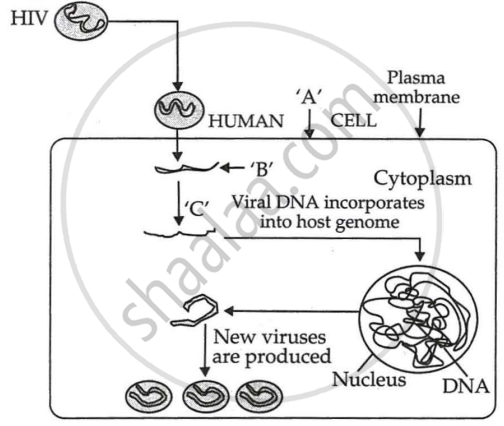
- Name the human cell ‘A’ HIV enters into.
- Mention the genetic material ‘B’ HIV releases into the cell.
- Identify enzyme ‘C’.
Chapter:
Following a road accident four injured persons were brought to a nearby clinic. The doctor immediately injected them with tetanus antitoxin.
- What is tetanus antitoxin?
- Why were the injured immediately injected with this antitoxin?
- Name the kind of immunity this injection provided.
Chapter:
“The population of a metro city experiences fluctuations in its population density over a period of time.”
- When does the population in a metro city tend to increase?
- When does the population in metro city tend to decline?
- If ‘N’ is the population density at the time ‘t’, write the population density at the time ‘t + 1’.
Chapter:
Describe the process of megasporogenesis in an angiosperm.
Chapter:
Draw a diagram of the mature embryo sac of an angiospermic ovule and label any four parts in it.
Chapter: [1] Sexual Reproduction in Flowering Plants
Where and how in the testes process of spermatogenesis occur in humans?
Chapter:
Draw a diagram of a human sperm. Label any four parts and write their functions.
Chapter:
Why did T.H. Morgon select Drosophila melanogaster for his experiments?
Chapter:
How did T.H. Morgan disprove Mendelian dihybrid F2 phenotypic ratio of 9 : 3 : 3 : 1? Explain giving reasons.
Chapter:
List any four major goals of Human Genome project.
Chapter:
Write any four ways the knowledge from HGP is of significance for humans.
Chapter:
Name the insect that attacks cotton crops and causes lot of damage to the crop. How has Bt cotton plants overcome this problem and saved the crop? Explain.
Chapter:
Explain the different steps carried out in Polymerase Chain Reaction, and the specific roles of the enzymes used.
Chapter:
Mention the application of PCR in the field of biotechnology.
Chapter:
Mention the application of PCR in the field of diagnostics.
Chapter:
Other Solutions
Submit Question Paper
Help us maintain new question papers on Shaalaa.com, so we can continue to help studentsonly jpg, png and pdf files
CBSE previous year question papers Class 12 Biology with solutions 2019 - 2020
Previous year Question paper for CBSE Class 12 -2020 is solved by experts. Solved question papers gives you the chance to check yourself after your mock test.
By referring the question paper Solutions for Biology, you can scale your preparation level and work on your weak areas. It will also help the candidates in developing the time-management skills. Practice makes perfect, and there is no better way to practice than to attempt previous year question paper solutions of CBSE Class 12.
How CBSE Class 12 Question Paper solutions Help Students ?
• Question paper solutions for Biology will helps students to prepare for exam.
• Question paper with answer will boost students confidence in exam time and also give you an idea About the important questions and topics to be prepared for the board exam.
• For finding solution of question papers no need to refer so multiple sources like textbook or guides.
