Advertisements
Advertisements
Question
Describe the process of megasporogenesis in an angiosperm.
Advertisements
Solution 1
Megasporogenesis is the process by which megaspores form in angiosperms.
The process of megasporogenesis takes place in the following way:
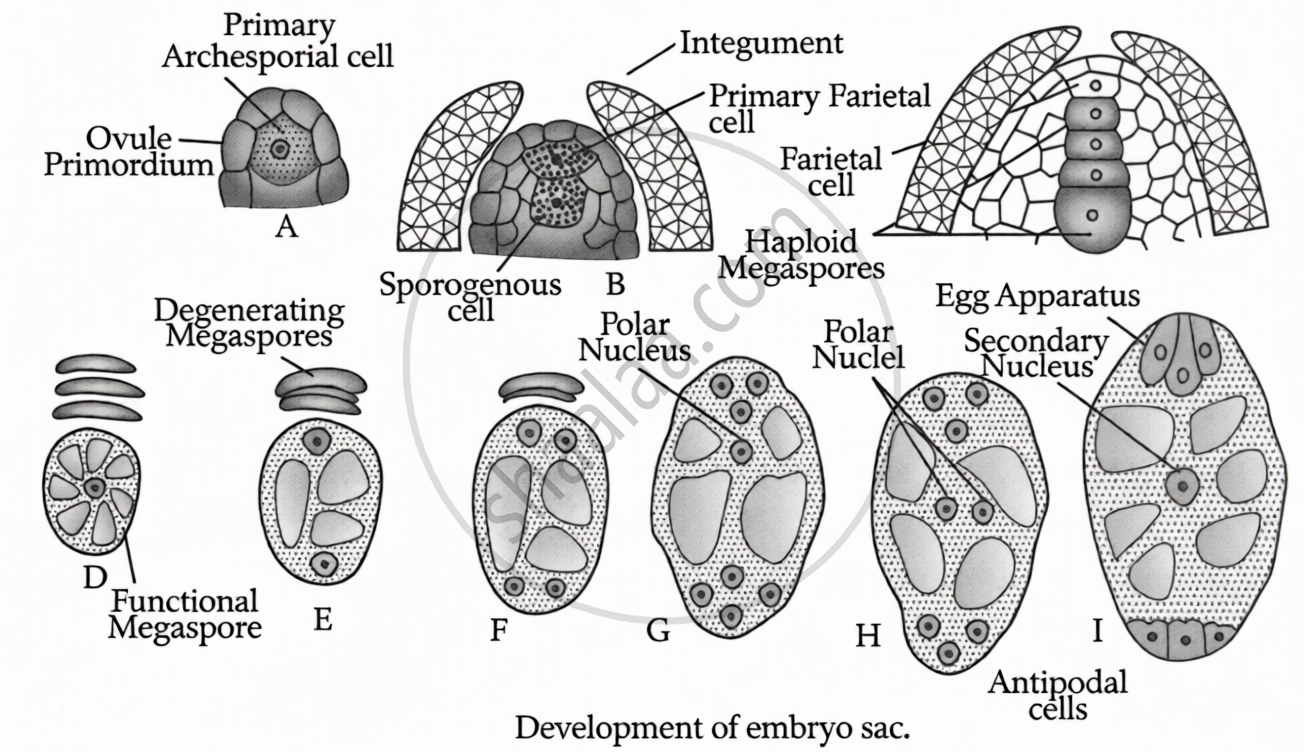
- Megaspore Mother Cell (MMC): The MMC develops from a big, diploid cell with a noticeable nucleus and thick cytoplasm inside the ovule.
- Meiosis: Meiosis, or reductional division, creates four haploid megaspores in the MMC. A linear tetrad is formed by the linear arrangement of the four megaspores.
- Degeneration and Function: Only one of the four megaspores survives and becomes functional in the majority of angiosperms; the other three decay.
- Embryo Sac Development: The embryo sac, also referred to as the female gametophyte, is formed by mitotic divisions of the functional megaspore.
- Eight-Nucleate Stage: As the embryo sac grows into an eight-nucleate structure, the nuclei move to different parts of the sac.
- Embryo Sac Structure: The egg cell, which is fertilized to create the embryo, has a central cell with two polar nuclei that fuse with a sperm nucleus to form the endosperm. Synergids with filiform apparatus that aid in attracting and directing the pollen tube and vegetative cells, known as antipodal cells, are all found in the embryo sac.
Solution 2
Megasporogenesis is the process by which the four megaspores are formed by meiosis from the megaspore mother cell (MMC) in the nucellus area. The Megaspore mother cell, which is big and has a noticeable nucleus and thick cytoplasm, is where it takes place inside the ovule. To create four megaspores, the MMC divides meiosis. Only one megaspore is active in most flowering plants, while the other three degenerate. The female gametophyte grows from the lone functional megaspore. Monosporic development is the process by which an embryo sac is formed from a single megaspore.