Advertisements
Advertisements
Question
You have a choice of three metals A, B, and C, of specific heat capacities 900 Jkg-1 °C-1, 380 Jkg-1 °C-1 and 460 Jkg-1 °C-1 respectively, to make a calorimeter. Which material will you select? Justify your answer.
Advertisements
Solution
Metal B with specific heat capacity 380 Jkg-1°C-1 should be selected to make a calorimeter. By selecting this metal, the heat capacity of the calorimeter will be reduced and the amount of heat energy consumed by it from its contents to acquire their final temperature will also be negligible.
APPEARS IN
RELATED QUESTIONS
How much heat energy is released when 5.0 g of water at 20℃ changes into ice at 0℃? Take specific heat capacity of water = 4.2 J g-1 K-1, Specific latent heat of fusion of ice = 336 J g-1.
What are the factors on which the quantity of heat given to a body depends?
m kg of a substance of specific heat capacity s J/kg °C is heated so that its temperature rises from θ1°C to θ2°C. Write down the expression for the heat Q supplied.
Give two reasons as to why copper is preferred over other metals for making calorimeters.
How much heat energy is necessary to raise the temperature of 5 kg of water from 20°C to 100°C?
Write a short note.
Specific heat capacity
Consider the statement given below and choose the correct option.
Assertion: Radiation is a form of heat transfer which takes place only in vacuum.
Reason: The thermal energy is transferred from one part of a substance to another part without the actual movement of the atoms or molecules.
Heat is applied to a rigid diatomic gas at constant pressure. The ratio ΔQ : ΔU : ΔW is ______.
The diagram below shows a cooling curve for 200 g of water. The heat is extracted at the rate of 100 Js-1. Answer the questions that follow:
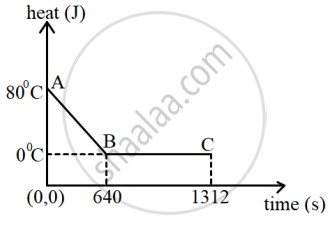
- Calculate specific heat capacity of water.
- Heat released in the region BC.
