Advertisements
Advertisements
Question
A pulley system with VR = 4 is used to lift a load of 175 kgf through a vertical height of 15 m. The effort required is 50 kgf in the downward direction. (g = 10 N kg-1)
Calculate:
- Distance moved by the effort
- Work done by the effort
- M.A. of the pulley system
- Efficiency of the pulley system
Advertisements
Solution
1) Displacement due to the effort is VR = 4
Load (L) = 175 kgf
Effort (E) = 50 kgf
Load displacement (dL) = 15 m
`VR = d_E/d_L`
Effort displacement (dE) = 4 × dL
= 4 × 15
= 60 m
Distance moved by the effort is 60 m
2) Work done by the effort is calculated using the following formula.
Work done by effort (WE) = `"Force"_"Effort" xx d_E`
WE = 50 × 60
= 3000 J
3) Mechanical advantage of the pulley system is calculated as
MA of the pulley system = `"Load (L)"/"Effort (E)"`
= `175/50`
= 3.5
4) Efficiency of the pulley is the ratio of work output to the work input required by the system
Efficiency of the pulley system (η) = `"Work output (Work Done by Load)"/"Work input (Work Done by Effort)"`
Work done by load = ForceLoad x dL
= 175 × 15
= 2625 kgf
:. η = `2625/3000`
= 0.875 × 100
= 87.5 %
APPEARS IN
RELATED QUESTIONS
A block and tackle system has V.R. = 5.
Rohan exerts a pull of 150 kgf. What is the maximum load he can raise with this pulley system if its efficiency = 75%?
What is the justification for using the pulley then ?
Define the following term in reference to a gear system for Gain in torque ?
In which direction does the force need to applied, when a single pulley is used with a mechanical advantage greater than one? How can you change the direction of force applied without altering its mechanical advantage? Draw a labelled diagram of the system.
The mechanical advantage of an ideal single movable pulley is ______.
A pulley system has a velocity ratio 3. Draw a diagram showing the point of application and direction of load (L), effort (E) and tension (T). It lifts a load of 150 N by an effort of 60 N. Calculate its mechanical advantage. Is the pulley system ideal? Give reason.
The diagram below shows a pulley arrangement :
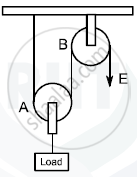
(i) Copy the diagram and mark the direction of tension on each strand of the string.
(ii) What is the velocity ratio of the arrangement ?
(iii) If the tension acting on the string is T, then what is the relationship between T and effort E ?
(iv) If the free end of the string moves through distance x, find the distance by which the load is raised.
Give a reason for the following:
In a single fixed pulley, the velocity ratio is always more than the mechanical advantage.
State two reasons, why the efficiency of a pulley system is not 100 percent?
Diagram given below shows an arrangement of four pulleys. A load L is attached to the movable lower block and effort E is applied at the free end of the string.
Copy the diagram; and

(i) Draw arrows to indicate tension in each part of the string; and
(ii) Calculate the mechanical advantage of the system.
