Advertisements
Advertisements
Question
You can buy solid air-freshners in shops. Do you think these substances are ionic or covalent? Why?
Advertisements
Solution
These substances are covalent in nature. While the covalent bonds within the molecules are strong, the intermolecular forces holding the individual molecules together are very weak. This gives them low melting points and allows them to sublimate or vaporise easily at room temperature, releasing fragrance molecules into the air. In contrast, ionic compounds are held together by strong electrostatic forces in a rigid lattice, meaning they cannot vaporise at room temperature and therefore do not give off an odour.
APPEARS IN
RELATED QUESTIONS
Elements forming ionic compounds attain noble gas configuration by either gaining or losing electrons from their outermost shells. Give reason to explain why carbon cannot attain noble gas configuration in this manner to form its compounds.
How does graphite act as a lubricant?
What type of bond is present in methane (CH4)?
In forming oxygen molecule, ______ electrons are shared by each atom of oxygen.
What is buckminsterfullerene?
How is buckminsterfullerene related to diamond and graphite?
Why is graphite used for making dry cell electrodes but diamond is not?
will CS2 conduct electricity or not?
give reason for your choice.
Explain why, diamond is hard while graphite is soft (though both are made of carbon atoms).
An element E exists in three allotropic forms A, B and C. In allotrope A, the atoms of element E are joined to form spherical molecules. In allotrope B, each atom of element E is surrounded by three other E atoms to form a sheet like structure. În allotrope C, each atom of element E is surrounded by four other E atoms to form a rigid structure.
(a) Name the element E.
(b) What is allotrope A.
(c) What is allotrope B?
(d) What is allotrope C?
(e) Which allotrope is used in making jewellery?
(f) Which allotrope is used in making anode of a dry cell?
What is the difference between ionic compounds and covalent compounds?
State the type of bonding in the following molecule.
Water
Give two example in following case:
Gaseous non polar covalent compound.
Draw an electron dot structure of the following molecule. (Without showing the circle) :
Ethene
Draw an electron dot structure of the following molecule. (Without showing the circle) :
Water
Draw electron - dot structure and structural formula of methane.
What do you understand by lone pair?
Explain the following:
Covalent compounds have low melting and boiling point.
(a) Compound X consists of molecules.
Choose the letter corresponding to the correct answer from the choices (a), (b), (c) and (d) given below
X is likely to have a :
Explain why carbon tetrachloride does not dissolve in water.
In the formation of electrovalent compounds, electrons are transferred from one element to another. How are electrons involved in the formation of a covalent compound?
Fill in the blank with correct word from the bracket.
Melting and boiling points of covalent compounds are generally ______ (low, high).
Acids dissolve in water and produce positively charged ions. Draw the structure of these positive ions.
Elements Q and S react together to form an ionic compound. Under normal conditions, which physical state will the compound QS exist in?
State the type of bond formed when the combining atom has small E.N. difference.
Element A has 2 electrons in its M shell. Element B has atomic number 7.
- Write equations to show how A and B form ions.
- If B is a diatomic gas, write the equation for the direct combination of A and B to form a compound.
- If the compound formed between A and B is melted and an electric current is passed through the molten compound, the element A will be obtained at the ______ and B at the ______ of the electrolytic cell.
Explain the following:
Polar covalent compounds conduct electricity?
Define the functional group and complete the following table.
| S.I. No. | Functional Group | Compound | Formula |
| (1) | ______________ | _______________ |
C2H5OH |
| (2) | _______________ | _______________ | CH3CHO |
Complete the following activity.
Write the names of the hydrocarbons for the following structural formula.
(isobutylene, cyclohexane, propene, cyclohexene, cyclopentane, benzene, propyne, isobutane, propane)
| \[\begin{array}{cc} \phantom{..}\ce{H}\phantom{...}\ce{H}\phantom{...}\ce{H}\\ \phantom{..}|\phantom{....}|\phantom{....}|\\ \ce{H - C - C- C- H}\\ \phantom{.}|\phantom{....}|\phantom{....}|\\ \ce{H - C - H}\\ |\\\ce{H}\end{array}\] |
Complete the following activity.
Write the names of the hydrocarbons for the following structural formula.
(isobutylene, cyclohexane, propene, cyclohexene, cyclopentane, benzene, propyne, isobutane, propane)
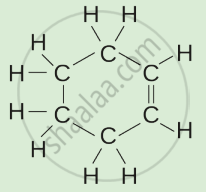 |
List two differences between the properties exhibited by covalent compounds and ionic compounds.
Give an example for each of the following statement.
A compound in which three covalent bonds are formed.
Identify the incorrect statement and correct them.
- Like covalent compounds, coordinate compounds also contain charged particles (ions). So they are good conductors of electricity.
- Ionic bond is a weak bond when compared to Hydrogen bond.
- Ionic or electrovalent bonds are formed by mutual sharing of electrons between atoms.
- Loss of electrons is called Oxidation and gain of electron is called Reduction.
- The electrons which are not involved in bonding are called valence electrons.
Which of the following compounds of carbon does not consist of ions?
Two carbon atoms can always form one or two covalent bonds.
What is a covalent bond?
The electron dot structure of chlorine molecule is:
The number of single and double bonds present in a molecule of benzene (C6H6) respectively, are ______.
