Advertisements
Advertisements
प्रश्न
You can buy solid air-freshners in shops. Do you think these substances are ionic or covalent? Why?
Advertisements
उत्तर
These substances are covalent in nature. While the covalent bonds within the molecules are strong, the intermolecular forces holding the individual molecules together are very weak. This gives them low melting points and allows them to sublimate or vaporise easily at room temperature, releasing fragrance molecules into the air. In contrast, ionic compounds are held together by strong electrostatic forces in a rigid lattice, meaning they cannot vaporise at room temperature and therefore do not give off an odour.
APPEARS IN
संबंधित प्रश्न
Give reason why carbon compounds are generally poor conductors of electricity.
Name the hardest natural substance known.
What type of bonds are present in a water molecule?
In forming oxygen molecule, ______ electrons are shared by each atom of oxygen.
What type of bond exists in CCl4?
Explain why:
Covalent compounds have generally low melting points.
Why is diamond used for making cutting tools (like glass cutters) but graphite is not?
Why is graphite used for making dry cell electrodes but diamond is not?
Explain why, ionic compounds conduct electricity in solution whereas covalent compounds do not conduct electricity.
What type of bonding would you expect between the following pair of elements?
Hydrogen and Chlorine
The atomic numbers of four elements P, Q, R and S are 6, 10, 12 and 17 respectively. Which two elements can combine to form a covalent compound?
A saturated hydrocarbon has fifty hydrogen atoms in its moleucle. The number of carbon atoms in its molecule will be ______.
The electronic configurations of three elements X, Y and Z are as follows:
| X | 2, 4 |
| Y | 2, 7 |
| Z | 2, 1 |
- Which two elements will combine to form an ionic compound?
- Which two elements will react to form a covalent compound?
Give reasons for your choice.
Which of the following cannot exhibit isomerism?
What is the difference between ionic compounds and covalent compounds?
Methane molecule is non-polar molecule. Explain.
State the type of bonding in the following molecule.
Water
Complete the following:
In case of non-polar covalent bond, the covalent bond is formed in the ______ of atoms and shared electrons are ______ distributed. (corner, middle, equally, unequally)
Give two example in following case:
Liquid non polar covalent compound.
Draw all possible structural formulae of the compound from its molecular formula given below.
C3H4
The following structural formula belongs to which carbon compound?
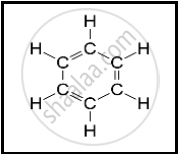
Choose and write the correct option.
Which type of carbon-carbon bonds are present in Vanaspati ghee?
Choose the correct answer from the options given below
Condition favorable for formation of a covalent bond is
Choose the correct answer from the options given below
Which one is not example of polar covalent compound?
The following table shows the electronic configuration of the elements W, X, Y, Z:
|
Element |
W |
X |
Y |
Z |
|
Electronic |
2,8,1 |
2,8,7 |
2,5 |
1 |
Answer the following questions based on the table above:
What type of bond is formed between Y and Z.
Draw the electron dot diagram and structure of nitrogen molecule.
Name two compounds that are covalent when taken pure but produce ions when dissolved in water.
Give an example of the covalent bond formed by
(i) Similar atoms (ii) Dissimilar atoms
Write an Explanation.
Alkene
Explain covalent bond with example.
Discuss in brief about the properties of coordinate covalent compounds.
Consider the coordination compound, K2[Cu(CN)4]. A coordinate covalent bond exists between:
Acetic acid was added to a solid X kept in a test tube. A colourless, odourless gas Y was evolved. The gas was passed through lime water, which turned milky. It was concluded that ______.
Carbon forms four covalent bonds by sharing its four valence electrons with four univalent atoms, e.g., hydrogen. After the formation of four bonds, carbon attains the electronic configuration of ______.
An element A is soft and can be cut with a knife. This is very reactive to air and cannot be kept open in air. It reacts vigorously with water. Identify the element from the following
Show the covalent bond formation in nitrogen molecule.
