Advertisements
Advertisements
Question
Write information about the given atomic numbers in the table.
| Atomic Number | Electronic configuration | Group | Period | Element |
| 10 | ||||
| 20 | ||||
| 7 |
Advertisements
Solution
| Atomic Number | Electronic configuration | Group | Period | Element |
| 10 | 2, 8 | 18 | 2 | Neon (Ne) |
| 20 | 2, 8, 8, 2 | 2 | 4 | Calcium (Ca) |
| 7 | 2, 5 | 15 | 2 | Nitrogen (N) |
APPEARS IN
RELATED QUESTIONS
Answer the following in respect of element `31/15 P`
Give its electronic configuration
Arrange the elements of second and third periods in increasing order of their atomic size (excluding noble gases).
Which is greater in size an atom or a cation?
Which is greater in size Fe2+ or Fe3+?
Arrange the following in order of increasing radii:
CI- , CI
Among the elements of the second period, Li to Ne, pick out the element with the largest atomic size
On moving from left to right in a periodic table, the size of the atom ______.
The size of an atom is indicated by its ______.
Right or wrong sentence.
Nanometer unit is used to measure atomic radius.
Write an explanation.
Atomic radius
Write scientific reason.
In same period, boron and oxygen elements have different atomic size.
Which of the following gives the correct increasing order of the atomic radii of O, F, and N?
When an atom of iodine becomes an iodine ion (I–) the radius will ______
Which among the following elements has the largest atomic radii?
Atomic number of a few elements are given below
10, 20, 7, 14
- Identify the elements
- Identify the Group number of these elements in the Periodic Table
- Identify the Periods of these elements in the Periodic Table
- What would be the electronic configuration for each of these elements?
- Determine the valency of these elements
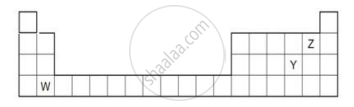
The diagram below shows part of the periodic table.
- Which elements would react together to form covalent compounds?
- Between the two elements W and Z, which will have a bigger atomic radius? Why?
Which one of the following has the largest atomic radius?
Give reason for the following:
The size of a Cl− ion is greater than the size of a Cl atom.
