Advertisements
Advertisements
प्रश्न
Write information about the given atomic numbers in the table.
| Atomic Number | Electronic configuration | Group | Period | Element |
| 10 | ||||
| 20 | ||||
| 7 |
Advertisements
उत्तर
| Atomic Number | Electronic configuration | Group | Period | Element |
| 10 | 2, 8 | 18 | 2 | Neon (Ne) |
| 20 | 2, 8, 8, 2 | 2 | 4 | Calcium (Ca) |
| 7 | 2, 5 | 15 | 2 | Nitrogen (N) |
APPEARS IN
संबंधित प्रश्न
Why is the size of sodium is greater than magnesium?
Which is greater in size Fe2+ or Fe3+?
Size of atom progressively becomes smaller when we move from sodium (Na) to chlorine (CI) in the third period of the periodic table?
Fill in the blank:
On moving across a period from right to left in the periodic table, the atomic size of the atom ___________.
Write the name and symbol of the element from the description.
The atom having the smallest atomic mass.
Among the elements of the second period, Li to Ne, pick out the element with the largest atomic size
Fill in the blank by selecting the correct word from the bracket.
If an element has seven electrons in its outermost shell then it is likely to have the _____ atomic size among all the elements in the same period.
Carbon belongs to the second period and Group 14. Silicon belongs to the third period and Group 14. If the atomic number of carbon is 6, the atomic number of silicon is ______
Which of the following is the correct order of atomic size?
Which of the following is the correct order of size?
Which of the following gives the correct increasing order of the atomic radii of O, F and N?
Which of the following are the characteristics of isotopes of an element?
- Isotopes of an element have same atomic masses
- Isotopes of an element have same atomic number
- Isotopes of an element show same physical properties
- Isotopes of an element show same chemical properties
Atomic number of a few elements are given below
10, 20, 7, 14
- Identify the elements
- Identify the Group number of these elements in the Periodic Table
- Identify the Periods of these elements in the Periodic Table
- What would be the electronic configuration for each of these elements?
- Determine the valency of these elements
The diagram below shows part of the periodic table.
- Which elements would react together to form covalent compounds?
- Between the two elements W and Z, which will have a bigger atomic radius? Why?
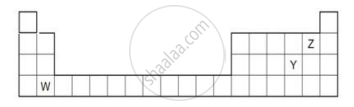
An element with the largest atomic radius among the following is ______.
In Period 3 of the Periodic Table, element B is placed to the left of element A. On the basis of this information, choose the correct word from the option to complete the following statement:
The element A would have ______ atomic size than B.
Which one has the largest size?
Give reason for the following:
The size of a Cl− ion is greater than the size of a Cl atom.
