Advertisements
Advertisements
Question
Write applications of co-ordination compounds in medicine and electroplating.
Advertisements
Solution
Applications of coordination compounds:
1) In medicine:
- Cisplatin [PtCl2(NH3)2] is useful in treatment of cancer.
- EDTA is useful in treatment of poisoning by lead.
2) In electroplating
Stable complexes with very small dissociation in solution are used for electroplating with silver and gold.
- The complex K[Ag(CN)2] is used for electroplating with silver
- The complex K[Au(CN)2] is used for electroplating with gold
APPEARS IN
RELATED QUESTIONS
Classify the following ligands into monodentate and polydentate —
- Ammonia
- Carbon monoxide
- Ethylene diamine
- Ethylene diamine tetra acetate ion
Amongst the following, the most stable complex is:
IUPAC name of the following compound is
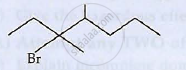
(a) 3 - Bromo- 3, 4- dimethylheptane
(b) 3, 4- dimethyl - 3- bromoheptane
(c) 5- Bromo- 4, 5- dimethylheptane
(d) 4, 5- dimethyl- 5- bromoheptane
Write structures of compounds A, B and C in of the following reactions

Write the IUPAC name of the following complex:
[Co(NH3)5(CO3)]Cl
Write the IUPAC name of the following coordination compound:
[Cr(NH3)4(H2O)2]Cl3
Write the IUPAC name of the following coordination compound:
[PtCl2(NH3)4][PtCl4]
The ligand triethylenetetramine is _______.
Write structures of compounds A and B of the following reaction :

Which of the following represents a chelate ligand?
In which of the following compounds the oxidation state of the nickel atom is 0?
What is the coordination number of chromium in \[\ce{[Cr(NH3)2(H2O2)2]Cl3}\]?
Which of the following complexes are heteroleptic?
(i) \[\ce{[Cr(NH3)6]^{3+}}\]
(ii) \[\ce{[Fe(NH3)4]Cl2]^+}\]
(iii) \[\ce{[Mn(CN)6]^{4-}}\]
(iv) \[\ce{[Co(NH3)4]Cl2]}\]
A complex of the type \[\ce{[M(AA)2X2]^{n+}}\] is known to be optically active. What does this indicate about the structure of the complex? Give one example of such complex.
Match the complex ions given in Column I with the colours given in Column II and assign the correct code:
| Column I (Complex ion) | Column II (Colour) |
| A. \[\ce{[Co(NH3)6]^{3+}}\] | 1. Violet |
| B. \[\ce{[Ti(H2O)6]^{3+}}\] | 2. Green |
| C. \[\ce{[Ni(H2O)6]^{2+}}\] | 3. Pale blue |
| D. \[\ce{(Ni(H2O)4 (en)]^{2+} (aq)}\] | 4. Yellowish orange |
| 5. Blue |
What is the relationship between observed colour of the complex and the wavelength of light absorbed by the complex?
The oxidation state of Fe in the brown ring complex [F3(H2O)5NO]SO4 is
The most stable ion is ______.
Metal attached with EDTA in an octahedral complex, has coordination number ______.
What are Homoleptic complexes?
Why chelate complexes are more stable than complexes with unidentate ligands?
Given below are two statements.
Statement I: In CuSO4·5H2O, Cu-O bonds are present.
Statement II: In CuSO4·5H2O, ligands coordinating with Cu(II) ion are O- and S-based ligands.
In light of the above statement, choose the correct answer from the options given below.
The following ligand is:

Total sodium ions which are present in one formula unit of sodium ethane-1, 2-diaminetetraacetatochromate (II) and sodium hexanitrito cobaltate (III) are ______.
Assertion (A): EDTA is a hexadentate ligand.
Reason (R): EDTA has 2 nitrogen and 4 oxygen donor atoms.
What is meant by the chelate effect? Give an example.
In the complex ion \[\ce{[CoCl(en)2ONO]+}\], the coordination number and the oxidation number of the central metal ion are ______ and ______.
Give two examples of ambidentate ligands.
Statement I: [Co(NH3)6]3+ is a homoleptic compleх whereas [Co(NH3)4Cl2]+ is a heteroleptic complex.
Statement II: Complex [Co(NH3)6]3+ has only one kind of ligands but [Co(NH3)4Cl2]+ has more than one kind of ligands.
In the light of the above statements, Choose the correct answer form the options given below.
