Advertisements
Advertisements
Questions
Why are aryl halides less reactive towards nucleophilic substitution reactions than alkyl halides?
Why are aryl halides less reactive than alkyl halides towards nucleophilic substitution reactions?
Why are haloarenes less reactive towards nucleophilic substitution reactions as compared to haloalkanes?
Advertisements
Solution
Aryl halides are less reactive towards nucleophilic substitution reaction due to the following reasons.
- In haloarenes, the lone pair of electron on halogen are in resonance with benzene ring. So, C – Cl bond acquires partial double bond character which strengthen C – Cl bond and difficult to be substituted by nucleophile.
Therefore, they are less reactive towards nucleophilic substitution reaction.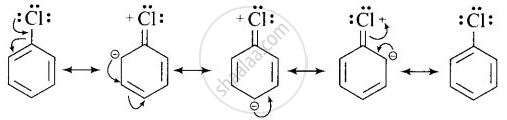
- In haloarenes, the carbon atom attached to halogen is sp2 hybridised. The sp2 hybridised carbon is more electronegative than sp3 hybridised carbon. This sp2-hybridised carbon in haloarenes can hold the electron pair of \[\ce{C - X}\] bond more tightly and make this \[\ce{C - Cl}\] bond shorter than \[\ce{C Cl}\] bond of haloalkanes.
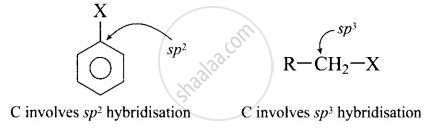
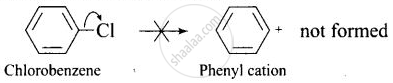
Since, it is difficult to break a shorter bond than a longer bond, therefore, halorenes are less reactive than haloalkanes. - In haloarenesm the phenyl cation is not stabilised by resonance therefore SN1 mechanism cannot be followed.
- Because of the repulsion between the nucleophile and electron-rich arenas, aryl halides are less reactive than alkyl halides.
RELATED QUESTIONS
How do you convert the following:
Ethanol to propanenitrile
In the following pair of halogen compounds, which compound undergoes a faster SN1 reaction?

Write the isomers of the compound having the formula C4H9Br.
Write the structure of the major organic product in the following reaction:
\[\ce{CH3CH(Br)CH2CH3 + NaOH ->[water]}\]
Write the structure of the major organic product in the following reaction:
\[\ce{CH3CH2Br + KCN ->[aq{.} ethanol]}\]
The treatment of alkyl chlorides with aqueous KOH leads to the formation of alcohols but in the presence of alcoholic KOH, alkenes are major products. Explain.
What happens when ethyl chloride is treated with aqueous KOH?
The stability order for carbocation is _______.
(A) 2° > 3° > 1°
(B) 3° > 2° > 1°
(C) 3° > 1° > 2°
(D) 1° > 3° > 2°
What is the action of the following on ethyl bromide?
silver acetate
Which of the following reactions is an example of nucleophilic substitution reaction?
Which of the following is an optically active compound?
SN1 reaction of alkyl halides lead to ___________.
The increasing order of nucleophilicity would be:
The correct order of increasing the reactivity of C–X bond towards nucleophile in following compounds.

(I)

(II)
(CH3)3CCl
(III)
(CH3)2CHCl
(IV)
Which of the following compound will undergo racemisation when reacts with aq. KOH?
(i)

(ii)
CH3CH2CH2Cl
(iii)
\[\begin{array}{cc}
\ce{CH3}\phantom{..}\\
|\phantom{....}\\
\ce{CH3-CH-CH2Cl}
\end{array}\]
(iv)
\[\begin{array}{cc}
\phantom{..}\ce{H}\\
\phantom{..}|\\
\ce{CH3-C-Cl}\\
\phantom{..}|\\
\phantom{.....}\ce{C2H5}
\end{array}\]
The increasing order of reactivity towards SN1 mechanism is:
(I) \[\begin{array}{cc}
\ce{CH3-CH-CH2-CH3}\\
|\phantom{........}\\
\ce{CH3}\phantom{.....}
\end{array}\]
(II) CH3CH2CH2Cl
(III) P–CH3O–C6H4–CH2Cl
Complete the following analogy:
Same molecular formula but different structures: A : : Non superimposable mirror images: B
Which reagent will you use for the following reaction?
\[\ce{CH3CH2CH2CH3 -> CH3CH2CH2CH2Cl + CH3CH2CHClCH3}\]
Discuss SN2 mechanism of methyl bromide using aqueous KOH.
Consider the reactions,
(i) \[\begin{array}{cc}
\phantom{}\ce{\underset{}{(CH3)2CH - CH2Br} ->[C2H5OH] \underset{}{(CH3)2CH - CH2OC2H5 + HBr}}\\
\end{array}\]
(ii) \[\begin{array}{cc}
\phantom{}\ce{\underset{}{(CH3)2CH - CH2Br} ->[C2H5O-] \underset{}{(CH3)2CH - CH2OC2H5 + Br-}}\\
\end{array}\]
The mechanisms of reactions (i) and (ii) are respectively:
