Advertisements
Advertisements
Question
Which monosaccharide units are present in starch, cellulose and glucose and which linkages link these units?
Advertisements
Solution
In starch a-glucose units are present, in cellulose β-D glucose units are present. In starch and glycogen glycosidic a-linkage is present and in cellulose glycosidic β-linkage is present between glucose units.
APPEARS IN
RELATED QUESTIONS
What are the expected products of hydrolysis of lactose?
Classify the following into monosaccharides and disaccharides.
Ribose, 2-deoxyribose, maltose, galactose, fructose and lactose
What are the hydrolysis products of sucrose?
The number of primary and secondary hydroxyl groups in ribose are -
(a) 1, 3
(b) 2, 3
(c) 3, 1
(d) 3, 2
The following molecule is called as:
\[\begin{array}{cc}
\ce{CHO}\phantom{..}\\
|\phantom{......}\\
\ce{(CHOH)4}\\
|\phantom{......}\\
\ce{CH2OH}
\end{array}\]
Glycosidic linkage is found between ____________.
Which of the following gives a positive Fehling solution test?
Glucose gives silver mirror test with Tollen’s reagent. It shows the presence of ____________.
The two functional groups present in a typical carbohydrate are:
Which of the following monosaccharide is pentose?
Monosaccharides usually contains ____________ carbon atoms.
A carbohydrate that cannot be hydrolysed into simpler units is called ____________.
Which of the following reagent cannot distinguish between glucose and fructose?
Three cyclic structures of monosaccharides are given below which of these are anomers.
| (I) |  |
| (II) | 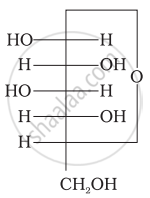 |
| (III) | 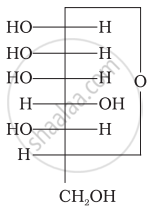 |
Which of the following monosaccharides are present as five membered cyclic structure (furanose structure)?
(i) Ribose
(ii) Glucose
(iii) Fructose
(iv) Galactose
What are glycosidic linkages? In which type of biomolecules are they present?
