Advertisements
Advertisements
Question
What are glycosidic linkages? In which type of biomolecules are they present?
Advertisements
Solution
The two monosaccharides are joined together by an oxide linkage formed by the loss of a water molecule. Such a linkage between two monosaccharides are held together by a glycosidic linkage between C1 of α-glucose and C2 of β-fructose. Since the reducing groups of glucose and fructose are involved in glycosidic bond formation, between two monosaccharide units through oxygen atom is called glycosidic linkage.
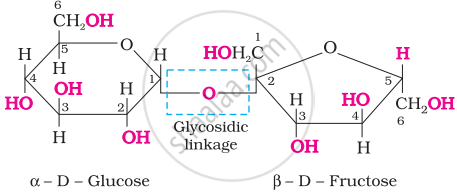
Sucrose
APPEARS IN
RELATED QUESTIONS
Write two main functions of carbohydrates in plants.
What are reducing sugars?
Classify the following into monosaccharides and disaccharides.
Ribose, 2-deoxyribose, maltose, galactose, fructose and lactose
The following molecule is called as:
\[\begin{array}{cc}
\ce{CHO}\phantom{..}\\
|\phantom{......}\\
\ce{(CHOH)4}\\
|\phantom{......}\\
\ce{CH2OH}
\end{array}\]
Glycosidic linkage is found between ____________.
Which of the following gives a positive Fehling solution test?
Glucose gives silver mirror test with Tollen’s reagent. It shows the presence of ____________.
The two functional groups present in a typical carbohydrate are:
Monosaccharides usually contains ____________ carbon atoms.
Glucose can’t be classified as ____________.
Which of the following reagent cannot distinguish between glucose and fructose?
The pair of compounds in which both the compounds give the positive test with Tollen’s reagent is:
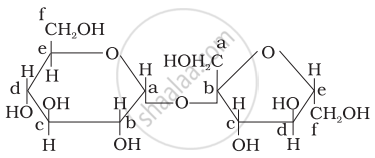
Structure of a disaccharide formed by glucose and fructose is given below. Identify anomeric carbon atoms in monosaccharide units.
Assertion: Deoxyribose, \[\ce{C5H10O4}\] is not a carbohydrate.
Reason: Carbohydrates are hydrates of carbon so compounds which follow \[\ce{C_x(H2O)_y}\] formula are carbohydrates.
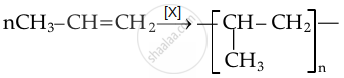
Reagent X is:
The following questions are case-based questions. Read the passage carefully and answer the questions that follow:
| Carbohydrates are optically active polyhydroxy aldehydes and ketones. They are also called saccharides. All those carbohydrates which reduce Fehling's solution and Tollen's reagent are referred to as reducing sugars. Glucose, the most important source of energy for mammals, is obtained by the hydrolysis of starch. Vitamins are accessory food factors required in the diet. Proteins are the polymers of α-amino acids and perform various structural and dynamic functions in the organisms. Deficiency of vitamins leads to many diseases. |
Answer the following:
(a) The penta-acetate of glucose does not react with Hydroxylamine. What does it indicate? (1)
(b) Why cannot vitamin C be stored in our body? (1)
(c) Define the following as related to proteins: (2)
- Peptide linkage
- Denaturation
OR
(c) Define the following as related to carbohydrates: (2)
- Anomers
- Glycosidic linkage
