Advertisements
Advertisements
प्रश्न
What are glycosidic linkages? In which type of biomolecules are they present?
Advertisements
उत्तर
The two monosaccharides are joined together by an oxide linkage formed by the loss of a water molecule. Such a linkage between two monosaccharides are held together by a glycosidic linkage between C1 of α-glucose and C2 of β-fructose. Since the reducing groups of glucose and fructose are involved in glycosidic bond formation, between two monosaccharide units through oxygen atom is called glycosidic linkage.
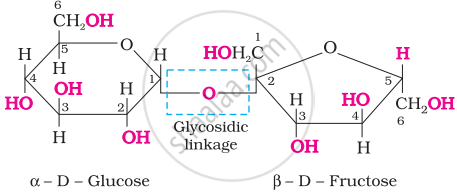
Sucrose
APPEARS IN
संबंधित प्रश्न
Glucose or sucrose are soluble in water but cyclohexane or benzene (simple six membered ring compounds) are insoluble in water. Explain.
Write two main functions of carbohydrates in plants.
What are reducing sugars?
Classify the following into monosaccharides and disaccharides.
Ribose, 2-deoxyribose, maltose, galactose, fructose and lactose
Glycosidic linkage is found between ____________.
Which of the following gives a positive Fehling solution test?
Glucose gives silver mirror test with Tollen’s reagent. It shows the presence of ____________.
The two functional groups present in a typical carbohydrate are:
Which of the following monosaccharide is pentose?
A carbohydrate that cannot be hydrolysed into simpler units is called ____________.
Reducing sugars reduce ____________.
Which of the following reagent cannot distinguish between glucose and fructose?
Three cyclic structures of monosaccharides are given below which of these are anomers.
| (I) |  |
| (II) | 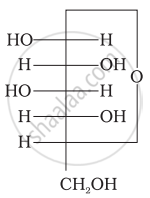 |
| (III) | 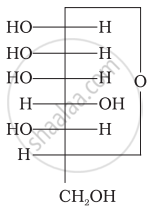 |
Structure of a disaccharide formed by glucose and fructose is given below. Identify anomeric carbon atoms in monosaccharide units.
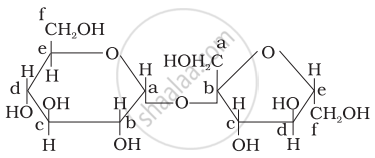
Which of the following monosaccharides are present as five membered cyclic structure (furanose structure)?
(i) Ribose
(ii) Glucose
(iii) Fructose
(iv) Galactose
Name the sugar present in milk. How many monosaccharide units are present in it? What are such oligosaccharides called?
Assertion: Deoxyribose, \[\ce{C5H10O4}\] is not a carbohydrate.
Reason: Carbohydrates are hydrates of carbon so compounds which follow \[\ce{C_x(H2O)_y}\] formula are carbohydrates.
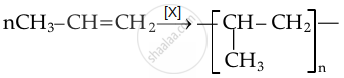
Reagent X is:
