Advertisements
Advertisements
Question
When a spherical mirror is held towards the sun and its sharp image is formed on a piece of a carbon paper for some time, a hole is burnt in the carbon paper.
What is the nature of spherical mirror?
Advertisements
Solution
The spherical mirror is concave.
APPEARS IN
RELATED QUESTIONS
One half of a convex lens of focal length 10 cm is covered with a black paper. Can such a lens produce an image of a complete object placed at a distance of 30 cm from the lens? Draw a ray diagram to justify your answer. A 4 cm tall object is placed perpendicular to its principal axis of a convex lens of focal length 20 cm. The distance of the object from the lens is 15 cm. Find the nature, position and the size of the image.
We can obtain an enlarged and erect image by a convex mirror.
What is the name of the phenomenon in which the right side of an object appears to be the left side of the image in a plane mirror?
When a spherical mirror is held towards the sun and its sharp image is formed on a piece of a carbon paper for some time, a hole is burnt in the carbon paper.
At which point of the spherical mirror the carbon paper is placed?
The shiny outer surface of a hollow sphere of aluminium of radius 50 cm is to be used as a mirror:
What will be the focal length of this mirror?
State the kind of mirror used
(a) by a dentist, and
(b) as a street light reflector.
Draw a ray diagram to show the formation of image of an object kept in front of a convex mirror. State three characteristics of the image.
Select the correct option:
A mirror forms a virtual image (diminished) of an object, whatever be the position of object:
Select the correct option:
Looking into a mirror one finds her image diminished, the mirror is:
Is real image always inverted?
Define the term Aperture.
What is the relationship between the focal length and radius of curvature?
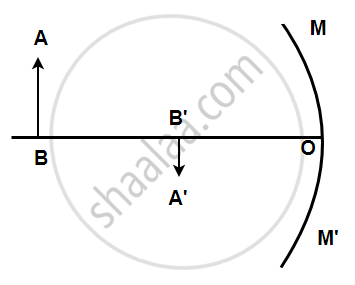
AB is the object, A'B' is the image, and MM' is the position of the mirror. Complete the ray diagram showing the formation of the image and find the focal length of the mirror.
A concave mirror can be used to produce a parallel beam of light. Draw a ray to illustrate this.
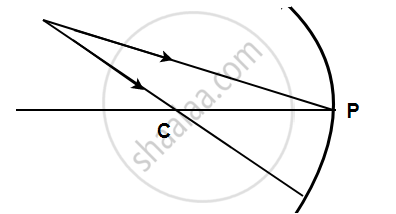
Complete the following diagrams shown in the following figures by drawing the reflected rays.
The spherical mirror with a reflecting surface curved inward is called
If the real image of a candle flame formed by a lens is three times the size of the flame and the distance between lens and image is 80 cm, at what distance should the candle be placed from the lens?
