Advertisements
Advertisements
Questions
Mention pollination types.
Explain the different types of pollination.
Advertisements
Solution
- Self-pollination: It is the transfer of pollen grains from the anther to the stigma of the same flower or another flower on the same plant.
- Cross-pollination: It is the transfer of pollen grains from the anther to the stigma of the flower present on two different plants.
APPEARS IN
RELATED QUESTIONS
Name the parts labelled as A, B, C and D in the diagram given below:-

A student while observing an embryo of a pea seed in the laboratory listed various parts of the embryo as given below:
Testa, Tegmen, Radicle, Plumule, Micropyle, Cotyledon.
On examining the list the teacher remarked that only three parts are correct. Select three correct parts from the above list:
(a) Testa, Radicle, Cotyleddon
(b) Tegmen, Radicle, Micropyle
(c) Cotyledon, Plumule, Testa
(d) Radicle, Cotyledon, Plumule
Name and differentiate between the two modes of pollination in flowering plants.
A student identified the various parts of an embryo of a gram seed and listed them as given below :
(I) Testa
(II) Plumule
(III) Radicle
(IV) Cotyledon
(V) Tegmen
Out of these the actual parts of the embryo are :
(A) I, II, III
(B) II, III, IV
(C) III, IV, V
(D) II, IV, V
Give one example of a unisexual flower.
Write the names of those parts of a flower which serve the same function as the following do in the animals :
(i) testis,
(ii) sperm,
(iii) ovary,
(iv) egg
The anther contains ______.
Name the swollen lower part of the carpel.
Where are a plant's sex organs located?
Fill in the following blank with suitable word :
The ovary of a flower becomes ....... after fertilisation.
Draw a neat sketch of the carpel of a flower. Mark in it stigma, style and ovary.
Explain the terms 'cross-pollination'?
Which among the following statements are true for unisexual flowers?
(i) They possess both stamen and pistil
(ii) They possess either stamen or pistil
(iii) They exhibit cross pollination
(iv) Unisexual flower possessing only stamens cannot produce fruits
(a) (i) and (iv)
(b) (ii), (iii) and (iv)
(c) (ii) and (iii)
(d) (i), (iii) and (iv)
Put a tick mark (✓) against the correct alternative in the following statement
Pollen is produced in the:
Fill in the blank:
Seeds are formed from________.
State whether the following statement is true (T) or false (F):
Flowers which possess stamens and carpel are called unisexual.
Find the odd-one out, giving reason:
Anther, pollen grain, ovule male gamete
Mention the function of Flower.
Mention the function of Stigma.
What are the male and female gametes in a flowering plant?
You have to perform the experiment, "To identify the different parts of an embryo of a gram seed." Describe the procedure that you would follow.
Identify A, B, C and D in the given diagram and write their names.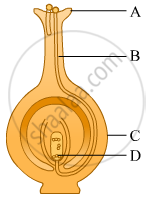
Explain the process of fertilisation in flowers.
What is phototropism?
What is cleistogamy? Write one advantage and one disadvantage of it, to the plant.
What is meant by pollination?
Pollen grains are formed by _________ division in locules of anthers.
Identify the parts A, B, C, and D?
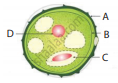
Flowers showing ornithophily show few characteristic like ______.
In a flowering plant, archesporium gives rise to ______.
What would be the number of chromosomes in the cells of the aleurone layer in a plant species with 8 chromosomes in its synergids?
The flower of the Hibiscus plant is ______
Which out of the following processes does not lead to the formation of clones.
Complete the table
| Carly x | ______ | ______ |
| ______ | petal | attract insects |
| Androecium | ______ | Male reproductive part |
| ______ | ______ | Female reproductive part. |
The ovaries of different flowers may contain ______.
Double fertilization means ______.
Give any two examples of agents of pollination.
