Advertisements
Advertisements
Question
What happens when glucose is treated with hydroxylamine?
Advertisements
Solution
Action of hydroxylamine (NH2OH) on glucose: The reaction of glucose with
hydroxylamine gives an oxime. This indicates the presence of carbonyl group.

APPEARS IN
RELATED QUESTIONS
Draw the simple Fisher projection formulae of D - (+) - glucose and D - (-) - fructose
Enumerate the reactions of D-glucose which cannot be explained by its open chain structure.
Enlist the properties of glucose that can not be explained on the basis of open chain structure of it
Glucose on reaction with HI gives n-hexane. What does it suggest about the structure of glucose?
Differentiable between the following:
Amylose and Amylopectin
What do you observe when glucose solution is heated with Tollen’s reagent?
Write the reactions involved when D-glucose is treated with the following reagent:
H2N-OH
Write the reaction involved when D-glucose is treated with the following reagent:
(CH3CO)2O
The following compound can be called as:

Choose the appropriate answer(s) for the below representation from the options given

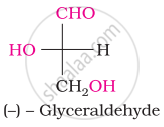
Oxime is formed by treating glucose with ____________.
The symbols D and L represents ____________.
Glucose does not react with ____________.
Which of the following properties of glucose cannot be explained by its open chain structure?
(i) Glucose does not form hydrogen sulphite with NaHSO3.
(ii) On oxidation with HNO3 glucose gives saccharic acid.
(iii) Glucose is found to exist in two different crystalline forms which are named as α and β.
Which is the least stable form of glucose?
The number of chiral carbon atoms present in cyclic structure α-D(+) glucose:
The α-D glucose and β-D glucose differ from each other due to difference in carbon atom with respect to its ____________.
The two forms of D-glucopyranose obtained from the solution of D-glucose are called ____________.
The letter D and L in carbohydrates represent ____________.
The number of chiral carbons in ß-D(+) glucose is ____________.
Which one is correct?
Which of the following pairs represents anomers?
Three structures are given below in which two glucose units are linked. Which of these linkages between glucose units are between C1 and C4 and which linkages are between C1 and C6?
| (I) |  |
| (II) |  |
| (III) |  |
Why does compound (A) given below not form an oxime?

(A)
Account for the following:
What happens when D – glucose is treated with the following reagents
Bromine water
Consider the following reactions:
(i) \[\ce{Glucose + R-OH ->[Conc. HNO3] [A] ->[X eq of][(CH3CO)2O] Acetyl derivative}\]
(ii) \[\ce{Glucose ->[Ni/H2] [A] ->[Y eq of][(CH3CO)2O] Acetyl derivative}\]
(iii) \[\ce{Glucose ->[Z eq of][(CH3CO)2O] Acetyl derivative}\]
'X, 'Y' and 'Z' in these reactions are respectively:
Match List - I with List - II.
| List I | List II | ||
| (A) | Glucose + HI | (I) | Gluconic acid |
| (B) | Glucose + Br2 water | (II) | Glucose pentacetate |
| (C) | Glucose + acetic anhydride | (III) | Saccharic acid |
| (D) | Glucose + HNO3 | (IV) | Hexane |
Choose the correct answer from the options given below:
The reagents with which glucose does not react to give the corresponding tests/products are:
- Tollen’s reagent
- Schiff’s reagent
- HCN
- NH2OH
- NaHSO3
Choose the correct options from the given below:
