Advertisements
Advertisements
प्रश्न
What happens when glucose is treated with hydroxylamine?
Advertisements
उत्तर
Action of hydroxylamine (NH2OH) on glucose: The reaction of glucose with
hydroxylamine gives an oxime. This indicates the presence of carbonyl group.

APPEARS IN
संबंधित प्रश्न
Draw the simple Fisher projection formulae of D - (+) - glucose and D - (-) - fructose
How many moles of acetic anhydride will be required to form glucose pentaacetate from 2M of glucose?
(a) 2
(b) 5
(c) 10
(d) 2.5
Maltose is a
(a) Polysaccharide
(b) Disaccharide
(c) Trisaccharide
(d) Monosaccharide
Write the product when D-glucose reacts with conc. HNO3.
Differentiable between the following:
Amylose and Amylopectin
What do you observe when glucose solution is heated with Tollen’s reagent?
Fill in the blanks by choosing the appropriate word/words from those given in the brackets:
(iodoform, acetaldehyde, positive, greater, acidic, acetone, disaccharide, negative, increases, glucose, decreases, chloroform, polysaccharide, lactose, lesser, basic, cationic hydrolysis, anionic hydrolysis)
Sucrose is a _________ and yields upon hydrolysis, a mixture of ________ and fructose.
Write the reaction involved when D-glucose is treated with the following reagent:
Br2 water
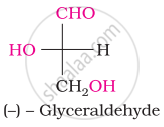
The spatial arrangement of the given molecule is denoted by:

The number of asymmetric carbon atom(s) below the figure is/are

Oxime is formed by treating glucose with ____________.
Glucose does not give Schiff’s test because of the formation of cyclic ____________.
Which one of the following compounds is different from the rest?
Which of the following reactions of glucose can be explained only by its cyclic structure?
The two forms of D-glucopyranose obtained from the solution of D-glucose are called ____________.
The letter D and L in carbohydrates represent ____________.
Which one is correct?
Which one of the following reactions is not explained by the open chain Structure of glucose?
Glucose with excess of phenyl hydrazine forms ______.
Match List - I with List - II.
| List I | List II | ||
| (A) | Glucose + HI | (I) | Gluconic acid |
| (B) | Glucose + Br2 water | (II) | Glucose pentacetate |
| (C) | Glucose + acetic anhydride | (III) | Saccharic acid |
| (D) | Glucose + HNO3 | (IV) | Hexane |
Choose the correct answer from the options given below:
When D-glucose reacts with HI, it forms ______.
Give the reaction of glucose with hydrogen cyanide. Presence of which group is confirmed by this reaction?
