Advertisements
Advertisements
प्रश्न
How will you distinguish 1° and 2° hydroxyl groups present in glucose? Explain with reactions.
Advertisements
उत्तर
On oxidation with nitric acid, glucose as well as gluconic acid both yield a dicarboxylic acid, saccharic acid. This indicates the presence of a primary alcoholic (–OH) group in glucose.
\[\begin{array}{cc}
\phantom{.......}\ce{CHO}\phantom{..............}\ce{COOH}\phantom{............}\ce{COOH}\phantom{....}\\
\phantom{......}|\phantom{...................}|\phantom{..................}|\phantom{........}\\
\phantom{.....}\ce{(CHOH)4 ->[Oxidation] (CHOH)4 <-[Oxidation] (CHOH)4}\\
\phantom{......}|\phantom{...................}|\phantom{..................}|\phantom{........}\\
\phantom{......}\ce{CH2OH}\phantom{............}\ce{\underset{acid}{\underset{Saccharic}{COOH}}\phantom{............}\ce{\underset{acid}{\underset{Gluconic}{CH2OH}}}\phantom{..}}\\
\end{array}\]
Acetylation of glucose with acetic anhydride gives glucose pentaacetate which confirms the presence of five –OH groups. Since it exists as a stable compound, five –OH groups should be attached to different carbon atoms.
\[\begin{array}{cc}
\phantom{...}\ce{CHO}\phantom{..................}\ce{CHO}\phantom{......}\ce{O}\phantom{..........}\\
\phantom{........}|\phantom{.......................}|\phantom{..........}||\phantom{...............}\\
\phantom{}\ce{(CHOH)4 ->[Acetic anhydride] (CH - O - C - CH3)4}\\
\phantom{.}|\phantom{.......................}|\phantom{...................}\\
\phantom{.....}\ce{CH2OH}\phantom{................}\ce{CH2 - O - C - CH3}
\phantom{.....}\\
\end{array}\]
APPEARS IN
संबंधित प्रश्न
How many moles of acetic anhydride will be required to form glucose pentaacetate from 2M of glucose?
(a) 2
(b) 5
(c) 10
(d) 2.5
Fill in the blanks by choosing the appropriate word/words from those given in the brackets:
(iodoform, acetaldehyde, positive, greater, acidic, acetone, disaccharide, negative, increases, glucose, decreases, chloroform, polysaccharide, lactose, lesser, basic, cationic hydrolysis, anionic hydrolysis)
Sucrose is a _________ and yields upon hydrolysis, a mixture of ________ and fructose.
Answer the following question.
What is the basic structural difference between glucose and fructose?
Write the reaction involved when D-glucose is treated with the following reagent:
Br2 water
The spatial arrangement of the given molecule is denoted by:

Choose the appropriate answer(s) for the below representation from the options given

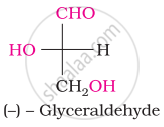
The number of asymmetric carbon atom(s) below the figure is/are

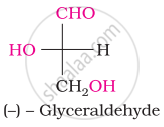
Oxime is formed by treating glucose with ____________.
Glucose does not react with ____________.
Glucose is found to exist in two different α and β crystalline forms. These forms can be obtained by:
(i) The α form of glucose is obtained by crystallisation from a concentrated solution of glucose at 303 K.
(ii) The β form of glucose is obtained by crystallisation from a concentrated solution of glucose at 303 K.
(iii) The β form is obtained by crystallisation from hot and saturated aqueous solution at 371 K.
(iv) The α form is obtained by crystallisation from hot and saturated aqueous solution at 371 K.
Reduction of glucose by HI suggest that ____________.
Which of the following reactions of glucose can be explained only by its cyclic structure?
A solution of D-glucose in water rotates the plane polarised light ____________.
Which one of the following reactions is not explained by the open chain Structure of glucose?
In the following reaction, identify A and B:
\[\begin{array}{cc}
\ce{C6H12O6 ->[Acetic anhydride] A}\\
\downarrow \text{Conc. nitric acid}\phantom{...}\\
\ce{B}\phantom{.................}\end{array}\]
Which of the following pairs represents anomers?
Assertion: D (+) – Glucose is dextrorotatory in nature.
Reason: ‘D’ represents its dextrorotatory nature.
On the basis of which evidences D-glucose was assigned the following structure?
\[\begin{array}{cc}
\ce{CHO}\\
|\phantom{....}\\
\phantom{..}\ce{(CHOH)4}\\
|\phantom{....}\\
\phantom{..}\ce{CH2OH}
\end{array}\]
Match List - I with List - II.
| List I | List II | ||
| (A) | Glucose + HI | (I) | Gluconic acid |
| (B) | Glucose + Br2 water | (II) | Glucose pentacetate |
| (C) | Glucose + acetic anhydride | (III) | Saccharic acid |
| (D) | Glucose + HNO3 | (IV) | Hexane |
Choose the correct answer from the options given below:
Give the reaction of glucose with hydrogen cyanide. Presence of which group is confirmed by this reaction?
