Advertisements
Advertisements
प्रश्न
On the basis of which evidences D-glucose was assigned the following structure?
\[\begin{array}{cc}
\ce{CHO}\\
|\phantom{....}\\
\phantom{..}\ce{(CHOH)4}\\
|\phantom{....}\\
\phantom{..}\ce{CH2OH}
\end{array}\]
Advertisements
उत्तर
This structure was assigned on the basis of the following evidences:
1. Molecular formula: The molecular formula of glucose has been found to be \[\ce{C6H12O6}\].
2. Straight chain structure:
(i) When aqueous solution of glucose is treated with sodium amalgam (Na/Hg) or sodium borohydride, it is reduced to sorbitol (or glucitol) a hexahedric alcohol.
\[\begin{array}{cc}
\phantom{.}\ce{CHO}\phantom{.......................}\ce{CH2OH}\phantom{..}\\
\phantom{}|\phantom{...........................}|\phantom{........}\\
\ce{(CHOH)4 + 2[H] ->[Na amalgam] (CHOH)4}\\
\phantom{}|\phantom{...........................}|\phantom{........}\\\
\phantom{..}\ce{CH2OH}\phantom{....................}\ce{\underset{Sorbitol}{CH2OH}\phantom{....}}
\end{array}\]
(ii) Prolonged heating with hydriodic acid and red phosphorus at 100°C gives a mixture of n-hexane and 2-iodohexane.
\[\begin{array}{cc}
\ce{\underset{Glucose}{CH2OH(CHOH)4CHO} ->[Hl][red P, 100°C] \underset{n-hexane}{CH3(CH2)4CH3} + CH3CH(CH2)3CH3}\\
\phantom{............................................}|\\
\phantom{............................................}\ce{\underset{2-Iodohexane}{I}}
\end{array}\]
The formation of n-hexane suggests that all the six carbon atoms in glucose are arranged in a straight chain structure of glucose.
3. Presence of five hydroxyl (-OH) groups: On acetylation with acetic anhydride, glucose gives a pentaacetate. This confirms that glucose contains five –OH groups. We know that the presence of two or more –OH groups on the same carbon atom makes the molecules unstable. Now since glucose is a stable compound, therefore, the five -OH groups must present on different carbon atoms.
4. Presence of one primary alcoholic group: On oxidation with cone, nitric acid, both glucose and gluconic acid give the same dicarboxylic acid, saccharic acid or glucaric acid. The primary alcoholic group \[\ce{(CH2OH)}\] is always present at the end of the carbon chain.
5. Presence of an aldehyde (-CHO) group: Glucose reacts with hydroxylamine, \[\ce{NH2OH}\] to form glucose CHO oxime. Which suggest that glucose contains a carbonyl \[\ce{(CHOH)4}\] (>C = O) groups.
APPEARS IN
संबंधित प्रश्न
Draw the simple Fisher projection formulae of D - (+) - glucose and D - (-) - fructose
What do you observe when glucose solution is heated with Tollen’s reagent?
The following compound can be called as:

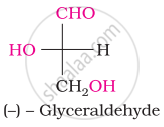
The spatial arrangement of the given molecule is denoted by:

The number of asymmetric carbon atom(s) below the figure is/are

What is the most abundant organic compound on earth?
Acetylation of glucose yields ____________.
Glucose does not react with ____________.
Which of the following properties of glucose cannot be explained by its open chain structure?
(i) Glucose does not form hydrogen sulphite with NaHSO3.
(ii) On oxidation with HNO3 glucose gives saccharic acid.
(iii) Glucose is found to exist in two different crystalline forms which are named as α and β.
Reduction of glucose by HI suggest that ____________.
Which of the following reactions of glucose can be explained only by its cyclic structure?
Choose the correct relationship for glucose and fructose:
Which one is correct?
Which one of the following reactions is not explained by the open chain Structure of glucose?
Assertion: D (+) – Glucose is dextrorotatory in nature.
Reason: ‘D’ represents its dextrorotatory nature.
What happens when D-glucose is treated with the following reagent?
HI
Consider the following reactions:
(i) \[\ce{Glucose + R-OH ->[Conc. HNO3] [A] ->[X eq of][(CH3CO)2O] Acetyl derivative}\]
(ii) \[\ce{Glucose ->[Ni/H2] [A] ->[Y eq of][(CH3CO)2O] Acetyl derivative}\]
(iii) \[\ce{Glucose ->[Z eq of][(CH3CO)2O] Acetyl derivative}\]
'X, 'Y' and 'Z' in these reactions are respectively:
Glucose with excess of phenyl hydrazine forms ______.
The reagents with which glucose does not react to give the corresponding tests/products are:
- Tollen’s reagent
- Schiff’s reagent
- HCN
- NH2OH
- NaHSO3
Choose the correct options from the given below:
