Advertisements
Advertisements
Question
Use Einstein's photoelectric equation to show how from this graph,
(i) Threshold frequency, and
(ii) Planck's constant can be determined.
Advertisements
Solution
Einstein's photoelectric equation is (K. E.)max = hv - W
⇒ (K. E.)max = hv - W = eVs
⇒ eVs = hv - W
⇒ `"V"_s = "h"/"e" "v" - "w"/"e""`
⇒ y = mx + c
As we can see a graph can be plotted between stopping potential and frequency of incident photons.
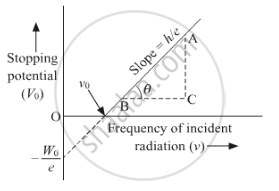
(i) Threshold frequency can be obtained from the graph where the graph cuts the x-axis, i.e. where the value of stopping potential becomes zero.
(ii) As the slope of the graph is `"h"/"e"`, hence by calculating the slope and multiplying it by the value of charge 'e' we can also find the value of plank's constant.
APPEARS IN
RELATED QUESTIONS
Light of wavelength 488 nm is produced by an argon laser which is used in the photoelectric effect. When light from this spectral line is incident on the emitter, the stopping (cut-off) potential of photoelectrons is 0.38 V. Find the work function of the material from which the emitter is made.
Briefly explain the three observed features which can be explained by Einstein’s photoelectric equation.
A monochromatic light source of intensity 5 mW emits 8 × 10¹⁵ photons per second. This light ejects photoelectrons from a metal surface. The stopping potential for this setup is 2.0 V. Calculate the work function of the metal.
(Use h = 6.63 × 10⁻³⁴J-s = 4.14 × 10⁻¹⁵ eV-s, c = 3 × 10⁸ m/s and me = 9.1 × 10⁻³¹kg)
How does one explain the emission of electrons from a photosensitive surface with the help of Einstein’s photoelectric equation?
A photon of wavelength 663 nm is incident on a metal surface. The work function of the metal is 1.50 eV. The maximum kinetic energy of the emitted photoelectrons is ______.
In \[E=h\nu\], what does \[\nu\] represent?
Which is Einstein’s photoelectric equation?
Which expression gives the threshold frequency?
Why does the maximum kinetic energy of photoelectrons increase when frequency increases?
If the frequency is above the threshold, how does greater intensity affect the number of electrons emitted?
