Advertisements
Advertisements
प्रश्न
Use Einstein's photoelectric equation to show how from this graph,
(i) Threshold frequency, and
(ii) Planck's constant can be determined.
Advertisements
उत्तर
Einstein's photoelectric equation is (K. E.)max = hv - W
⇒ (K. E.)max = hv - W = eVs
⇒ eVs = hv - W
⇒ `"V"_s = "h"/"e" "v" - "w"/"e""`
⇒ y = mx + c
As we can see a graph can be plotted between stopping potential and frequency of incident photons.
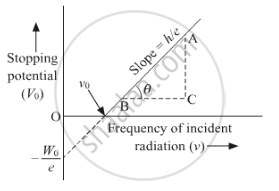
(i) Threshold frequency can be obtained from the graph where the graph cuts the x-axis, i.e. where the value of stopping potential becomes zero.
(ii) As the slope of the graph is `"h"/"e"`, hence by calculating the slope and multiplying it by the value of charge 'e' we can also find the value of plank's constant.
APPEARS IN
संबंधित प्रश्न
The work function for a certain metal is 4.2 eV. Will this metal give photoelectric emission for incident radiation of wavelength 330 nm?
A non-monochromatic light is used in an experiment on photoelectric effect. The stopping potential
How does one explain the emission of electrons from a photosensitive surface with the help of Einstein’s photoelectric equation?
Each photon has the same speed but different ______.
If c is the velocity of light in free space, the correct statements about photon among the following are:
- The energy of a photon is E = hv.
- The velocity of a photon is c.
- The momentum of a photon, ρ = `(h v)/c`.
- In a photon-electron collision, both total energy and total momentum are conserved.
- Photon possesses positive charge.
Choose the correct answer from the options given below:
What does light consist of in Einstein’s explanation?
In \[E=h\nu\], what does \[E\] represent?
Which is Einstein’s photoelectric equation?
What condition must be met for photoelectric emission to occur?
Why does the maximum kinetic energy of photoelectrons increase when frequency increases?
