Advertisements
Advertisements
प्रश्न
Use Einstein's photoelectric equation to show how from this graph,
(i) Threshold frequency, and
(ii) Planck's constant can be determined.
Advertisements
उत्तर
Einstein's photoelectric equation is (K. E.)max = hv - W
⇒ (K. E.)max = hv - W = eVs
⇒ eVs = hv - W
⇒ `"V"_s = "h"/"e" "v" - "w"/"e""`
⇒ y = mx + c
As we can see a graph can be plotted between stopping potential and frequency of incident photons.
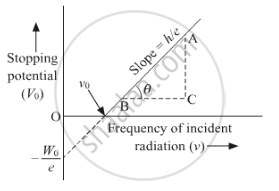
(i) Threshold frequency can be obtained from the graph where the graph cuts the x-axis, i.e. where the value of stopping potential becomes zero.
(ii) As the slope of the graph is `"h"/"e"`, hence by calculating the slope and multiplying it by the value of charge 'e' we can also find the value of plank's constant.
APPEARS IN
संबंधित प्रश्न
Light of wavelength 488 nm is produced by an argon laser which is used in the photoelectric effect. When light from this spectral line is incident on the emitter, the stopping (cut-off) potential of photoelectrons is 0.38 V. Find the work function of the material from which the emitter is made.
Is p − E/c valid for electrons?
A small metal plate (work function φ) is kept at a distance d from a singly-ionised, fixed ion. A monochromatic light beam is incident on the metal plate and photoelectrons are emitted. Find the maximum wavelength of the light beam, so that some of the photoelectrons may go round the ion along a circle.
The minimum energy required to remove an electron is called ______.
A student performs an experiment on photoelectric effect, using two materials A and B. A plot of Vstop vs ν is given in Figure.

- Which material A or B has a higher work function?
- Given the electric charge of an electron = 1.6 × 10⁻¹⁹ C, find the value of h obtained from the experiment for both A and B.
Comment on whether it is consistent with Einstein’s theory:
What happens to photon energy when frequency increases?
What condition must be met for photoelectric emission to occur?
How is the work function related to the threshold frequency \[\nu_0\]?
Which expression gives the threshold frequency?
Why does the maximum kinetic energy of photoelectrons increase when frequency increases?
