Advertisements
Advertisements
Question
Under which condition laws of Boyle, Charles, and Gay-Lussac are valid?
Advertisements
Solution 1
The laws of Boyle, Charles, and Gay-Lussac are strictly valid for real gases, only if the pressure of the gas is not too high and the temperature is not close to the liquefaction temperature of the gas.
Solution 2
- Boyle’s Law `(P alpha 1/V "at constant T")`: Boyle’s Law states that pressure (P) and volume (V) are inversely proportional when temperature and the number of gas molecules remain constant. It is valid only if the temperature remains constant and the gas behaves ideally.
- Charles’s Law (V ∝ T at constant P): Charles’s Law states that volume (V) and absolute temperature (T) are directly proportional when pressure and the number of gas molecules remain constant. It is valid only if the pressure remains constant and the gas follows ideal gas behaviour.
- Gay-Lussac’s Law (P ∝ T at constant V): Gay-Lussac’s Law states that pressure (P) and absolute temperature (T) are directly proportional when volume and the number of gas molecules remain constant. It is valid only if the volume remains constant and the gas exhibits ideal behaviour.
APPEARS IN
RELATED QUESTIONS
It is said that the assumptions of kinetic theory are good for gases having low densities. Suppose a container is so evacuated that only one molecule is left in it. Which of the assumptions of kinetic theory will not be valid for such a situation? Can we assign a temperature to this gas?
If the molecules were not allowed to collide among themselves, would you expect more evaporation or less evaporation?
Is it possible to boil water at room temperature, say 30°C? If we touch a flask containing water boiling at this temperature, will it be hot?
Which of the following parameters is the same for molecules of all gases at a given temperature?
The mean speed of the molecules of a hydrogen sample equals the mean speed of the molecules of a helium sample. Calculate the ratio of the temperature of the hydrogen sample to the temperature of the helium sample.
Use R = 8.314 JK-1 mol-1
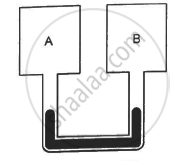
Figure shows two rigid vessels A and B, each of volume 200 cm3, containing an ideal gas (Cv = 12.5 J K−1 mol−1). The vessels are connected to a manometer tube containing mercury. The pressure in both the vessels is 75 cm of mercury and the temperature is 300 K. (a) Find the number of moles of the gas in each vessel. (b) 5.0 J of heat is supplied to the gas in vessel A and 10 J to the gas in vessel B. Assuming there's no appreciable transfer of heat from A to B, calculate the difference in the heights of mercury in the two sides of the manometer. Gas constant, R = 8.3 J K−1 mol−1.
An adiabatic cylindrical tube of cross-sectional area 1 cm2 is closed at one end and fitted with a piston at the other end. The tube contains 0.03 g of an ideal gas. At 1 atm pressure and at the temperature of the surrounding, the length of the gas column is 40 cm. The piston is suddenly pulled out to double the length of the column. The pressure of the gas falls to 0.355 atm. Find the speed of sound in the gas at atmospheric temperature.
If a = 0.72 and r = 0.24, then the value of tr is ______.
Answer in brief:
Show that rms velocity of an oxygen molecule is `sqrt2` times that of a sulfur dioxide molecule at S.T.P.
Compare the rms speed of hydrogen molecules at 127°C with rms speed of oxygen molecules at 27ºC given that molecular masses of hydrogen and oxygen are 2 and 32 respectively.
In an ideal gas, the molecules possess ______.
Calculate the ratio of the mean square speeds of molecules of a gas at 30 K and 120 K.
Two vessels A and B are filled with the same gas where the volume, temperature, and pressure in vessel A is twice the volume, temperature, and pressure in vessel B. Calculate the ratio of the number of molecules of the gas in vessel A to that in vessel B.
Earth’s mean temperature can be assumed to be 280 K. How will the curve of blackbody radiation look like for this temperature? Find out λmax. In which part of the electromagnetic spectrum, does this value lie? (Take Wien's constant b = 2.897 × 10⁻³ m K)
The power radiated by a perfect blackbody depends only on its ______
Calculate the energy radiated in one minute by a blackbody of surface area 200 cm2 at 127 °C (σ = 5.7 x 10⁻⁸ J m-2 s-1 K-4)
Above what temperature, all bodies radiate electromagnetic radiation?
The average K.E. of hydrogen molecules at 27° C is E. The average K.E. at 627° C is ____________.
A ring of mass m and radius r rotates about an axis passing through its centre and perpendicular to its plane with angular velocity `omega`. Its kinetic energy is ______.
Average kinetic energy of H2 molecule at 300K is 'E'. At the same temperature, average kinetic energy of O2 molecule will be ______.
Assuming the expression for the pressure exerted by the gas on the wall of the container, it can be shown that pressure is ______.
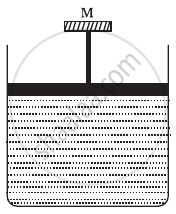
A cylinder containing an ideal gas is in vertical position and has a piston of mass M that is able to move up or down without friction (Figure). If the temperature is increased ______.
Volume versus temperature graphs for a given mass of an ideal gas are shown in figure at two different values of constant pressure. What can be inferred about relation between P1 and P2?

The molecules of a given mass of a gas have root mean square speeds of 100 ms−1 at 27°C and 1.00 atmospheric pressure. What will be the root mean square speeds of the molecules of the gas at 127°C and 2.0 atmospheric pressure?
Two molecules of a gas have speeds of 9 × 10 6 ms−1 and 1 × 10⁶ ms−1, respectively. What is the root mean square speed of these molecules?
The Q-value of a nuclear reaction and kinetic energy of the projectile particle, KP are related as ______.
Assuming the expression for the pressure P exerted by an ideal gas, prove that the kinetic energy per unit volume of the gas is `3/2` P.
At what temperature will therms velocity of a gas be four times its value at STP?
