Advertisements
Advertisements
Question
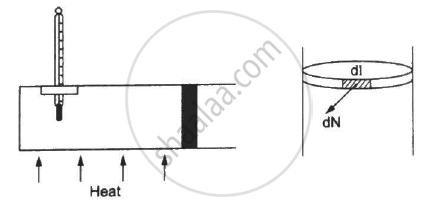
Figure shows a cylindrical tube of radius 5 cm and length 20 cm. It is closed by a tight-fitting cork. The friction coefficient between the cork and the tube is 0.20. The tube contains an ideal gas at a pressure of 1 atm and a temperature of 300 K. The tube is slowly heated and it is found that the cork pops out when the temperature reaches 600 K. Let dN denote the magnitude of the normal contact force exerted by a small length dlof the cork along the periphery (see the figure). Assuming that the temperature of the gas is uniform at any instant, calculate `(dN)/(dt)`.
Advertisements
Solution
Here ,
`P_1 = 10^5 "Pa"`
`A = π(0.05)^2`
L = 0.2 m
`V = AL = 0.0016 \text ( m)^3`
`T_1 = 300 K`
`T_2 = 600 K `
`µ = 0.20`
Applying 5 variable equation of state , we get
`(P_1V)/T_1 = (P_2V)/T_2`
⇒ `P_1/T_1 = P_2/T_2`
⇒ `P_2 = T_2/T_1 × P_1 = 600/300 × 10^5`
⇒ `P_2 = 2 × 10^5`
Net pressure , `P = P_2 - P_1 = 2 × 10^5 - 10^5 = 10^5`
Total force acting on the stopper = `PA = 10^5×pi×(0.05)^2`
Applying law of friction , we get
`F = µN = 0.2N`
⇒ `N = F/µ = (10^5×pi×(0.05)^2)/0.2`
`(dN)/(dl) = N/(2pir) = (10^5×pi×(0.05)^2)/(0.2×2pi×(0.05))=0.125×10^5`
⇒ `(dN)/(dl) = 1.25×10^4 N/m`
APPEARS IN
RELATED QUESTIONS
The process on an ideal gas, shown in figure, is
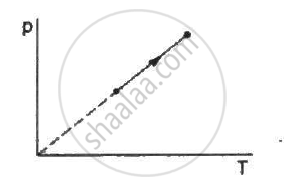
Figure shows two vessels A and B with rigid walls containing ideal gases. The pressure, temperature and the volume are pA, TA, V in the vessel A and pB, TB, V in the vessel B. The vessels are now connected through a small tube. Show that the pressure p and the temperature T satisfy `Ρ/T = 1/2 ({P_A}/{T_A}+{P_B}/{T_B))` when equilibrium is achieved.

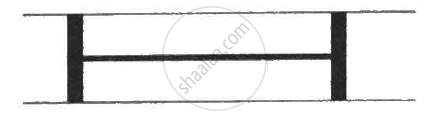
Figure shows a cylindrical tube of cross-sectional area A fitted with two frictionless pistons. The pistons are connected to each other by a metallic wire. Initially, the temperature of the gas is T0 and its pressure is p0 which equals the atmospheric pressure. (a) What is the tension in the wire? (b) What will be the tension if the temperature is increased to 2T0 ?
A glass contains some water at room temperature 20°C. Refrigerated water is added to it slowly. when the temperature of the glass reaches 10°C, small droplets condense on the outer surface. Calculate the relative humidity in the room. The boiling point of water at a pressure of 17.5 mm of mercury is 20°C and at 8.9 mm of mercury it is 10°C.
If a = 0.72 and r = 0.24, then the value of tr is ______.
In an ideal gas, the molecules possess ______.
Explain, on the basis of the kinetic theory of gases, how the pressure of a gas changes if its volume is reduced at a constant temperature.
Calculate the ratio of the mean square speeds of molecules of a gas at 30 K and 120 K.
The emissive power of a sphere of area 0.02 m2 is 0.5 kcal s-1m-2. What is the amount of heat radiated by the spherical surface in 20 seconds?
The number of degrees of freedom, for the vibrational motion of a polyatomic molecule, depends on the ______
The power radiated by a perfect blackbody depends only on its ______
Calculate the energy radiated in one minute by a blackbody of surface area 200 cm2 at 127 °C (σ = 5.7 x 10⁻⁸ J m-2 s-1 K-4)
Under which condition laws of Boyle, Charles, and Gay-Lussac are valid?
If the density of nitrogen is 1.25 kg/m3 at a pressure of 105 Pa, find the root mean square velocity of nitrogen molecules.
A ring of mass m and radius r rotates about an axis passing through its centre and perpendicular to its plane with angular velocity `omega`. Its kinetic energy is ______.
Average kinetic energy of H2 molecule at 300K is 'E'. At the same temperature, average kinetic energy of O2 molecule will be ______.
Assuming the expression for the pressure exerted by the gas on the wall of the container, it can be shown that pressure is ______.
The average translational kinetic energy of a molecule in a gas is 'E1'. The kinetic energy of the electron (e) accelerated from rest through p.d. 'V' volt is 'E2'. The temperature at which E1 = E2 is possible, is ______.
Assuming the expression for the pressure P exerted by an ideal gas, prove that the kinetic energy per unit volume of the gas is `3/2` P.
