Advertisements
Advertisements
प्रश्न
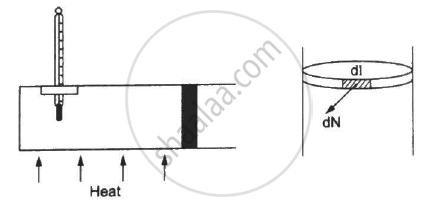
Figure shows a cylindrical tube of radius 5 cm and length 20 cm. It is closed by a tight-fitting cork. The friction coefficient between the cork and the tube is 0.20. The tube contains an ideal gas at a pressure of 1 atm and a temperature of 300 K. The tube is slowly heated and it is found that the cork pops out when the temperature reaches 600 K. Let dN denote the magnitude of the normal contact force exerted by a small length dlof the cork along the periphery (see the figure). Assuming that the temperature of the gas is uniform at any instant, calculate `(dN)/(dt)`.
Advertisements
उत्तर
Here ,
`P_1 = 10^5 "Pa"`
`A = π(0.05)^2`
L = 0.2 m
`V = AL = 0.0016 \text ( m)^3`
`T_1 = 300 K`
`T_2 = 600 K `
`µ = 0.20`
Applying 5 variable equation of state , we get
`(P_1V)/T_1 = (P_2V)/T_2`
⇒ `P_1/T_1 = P_2/T_2`
⇒ `P_2 = T_2/T_1 × P_1 = 600/300 × 10^5`
⇒ `P_2 = 2 × 10^5`
Net pressure , `P = P_2 - P_1 = 2 × 10^5 - 10^5 = 10^5`
Total force acting on the stopper = `PA = 10^5×pi×(0.05)^2`
Applying law of friction , we get
`F = µN = 0.2N`
⇒ `N = F/µ = (10^5×pi×(0.05)^2)/0.2`
`(dN)/(dl) = N/(2pir) = (10^5×pi×(0.05)^2)/(0.2×2pi×(0.05))=0.125×10^5`
⇒ `(dN)/(dl) = 1.25×10^4 N/m`
APPEARS IN
संबंधित प्रश्न
When we place a gas cylinder on a van and the van moves, does the kinetic energy of the molecules increase? Does the temperature increase?
Do you expect the gas in a cooking gas cylinder to obey the ideal gas equation?
The pressure of an ideal gas is written as \[P = \frac{2E}{3V}\] . Here E refers to
Find the number of molecules of an ideal gas in a volume of 1.000 cm3 at STP.
The average translational kinetic energy of air molecules is 0.040 eV (1 eV = 1.6 × 10⁻¹⁹J). Calculate the temperature of the air. Boltzmann constant k = 1.38 × 10⁻²³ J K−1.
0.040 g of He is kept in a closed container initially at 100.0°C. The container is now heated. Neglecting the expansion of the container, calculate the temperature at which the internal energy is increased by 12 J.
Use R = 8.3 J K-1 mol-1
Figure shows two vessels A and B with rigid walls containing ideal gases. The pressure, temperature and the volume are pA, TA, V in the vessel A and pB, TB, V in the vessel B. The vessels are now connected through a small tube. Show that the pressure p and the temperature T satisfy `Ρ/T = 1/2 ({P_A}/{T_A}+{P_B}/{T_B))` when equilibrium is achieved.

One mole of an ideal gas undergoes a process `P = (P_0)/(1+(V/V_0)^2` where `p_0` and `V_0` are constants . Find the temperature of the gas when `V=V_0` .
Calculate the ratio of the mean square speeds of molecules of a gas at 30 K and 120 K.
Earth’s mean temperature can be assumed to be 280 K. How will the curve of blackbody radiation look like for this temperature? Find out λmax. In which part of the electromagnetic spectrum, does this value lie? (Take Wien's constant b = 2.897 × 10⁻³ m K)
Calculate the value of λmax for radiation from a body having a surface temperature of 3000 K. (b = 2.897 x 10⁻³ m K)
Compare the rate of radiation of metal bodies at 727 °C and 227 °C.
The average translational kinetic energy of gas molecules depends on ____________.
A molecule consists of two atoms each of mass 'm' and separated by a distance 'd'. At room temperature the average rotational kinetic energy is 'E', then its angular frequency is ______.
An inflated rubber balloon contains one mole of an ideal gas, has a pressure p, volume V and temperature T. If the temperature rises to 1.1 T, and the volume is increased to 1.05 V, the final pressure will be ______.
A gas mixture consists of molecules of types A, B and C with masses mA > mB > mC. Rank the three types of molecules in decreasing order of rms speeds.
Explain why there is no atmosphere on moon.
23Ne decays to 23Na by negative beta emission. Mass of 23Ne is 22.994465 amu mass of 23Na is 22.989768 amu. The maximum kinetic energy of emitted electrons neglecting the kinetic energy of recoiling product nucleus is ______ MeV.
For a particle moving in vertical circle, the total energy at different positions along the path ______.
2000 calories of radiant heat is incident on a body. If the body absorbs 550 calories of heat, find the coefficient of emmission of the body.
