Advertisements
Advertisements
Question
An adiabatic cylindrical tube of cross-sectional area 1 cm2 is closed at one end and fitted with a piston at the other end. The tube contains 0.03 g of an ideal gas. At 1 atm pressure and at the temperature of the surrounding, the length of the gas column is 40 cm. The piston is suddenly pulled out to double the length of the column. The pressure of the gas falls to 0.355 atm. Find the speed of sound in the gas at atmospheric temperature.
Advertisements
Solution
Given:
Area of the tube, A = 1 cm2 = 1 × 10⁻⁴ m2
Mass of the gas, M = 0.03 g = 0.03 × 10⁻³ kg
Initial pressure, P = 1 atm = 105 Pascal
Initial length of the mercury column, L = 40 cm = 0.4 m
Final length of the mercury column, L1 = 80 cm = 0.8 m
Final pressure, P' = 0.355 atm
The process is adiabatic. So,
P(V)γ = P'(V')γ
⇒ 1 × (A × 0.4)γ = 0.355 × (A × 0.8)γ
⇒ 1 × 1 = 0.355 × 2γ
`=> 1/0.355 = 2^gamma`
`gamma "log" 2 = "log"(1/0.355)`
⇒ γ =1.4941
Speed of sound in the gas,
`"v" = sqrt((gamma"P")/ρ) = sqrt ((gamma"P")/("m"/"v"))`
`"v" = sqrt ((1.4941 xx 10^5)/("m"/"v")) = sqrt ((1.4941 xx 10^5)/(( 0.03 xx 10 ^-3)/(10 ^-4 xx 1 xx 0.4)`
⇒ v = 446.33 ≈ 447 m/s
APPEARS IN
RELATED QUESTIONS
When we place a gas cylinder on a van and the van moves, does the kinetic energy of the molecules increase? Does the temperature increase?
Can we define the temperature of (a) vacuum, (b) a single molecule?
An ideal gas is trapped between a mercury column and the closed-end of a narrow vertical tube of uniform base containing the column. The upper end of the tube is open to the atmosphere. The atmospheric pressure equals 76 cm of mercury. The lengths of the mercury column and the trapped air column are 20 cm and 43 cm respectively. What will be the length of the air column when the tube is tilted slowly in a vertical plane through an angle of 60°? Assume the temperature to remain constant.
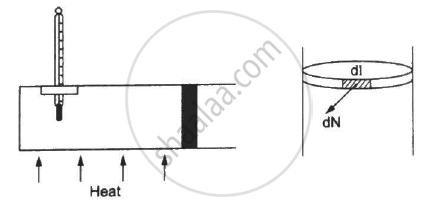
Figure shows a cylindrical tube of radius 5 cm and length 20 cm. It is closed by a tight-fitting cork. The friction coefficient between the cork and the tube is 0.20. The tube contains an ideal gas at a pressure of 1 atm and a temperature of 300 K. The tube is slowly heated and it is found that the cork pops out when the temperature reaches 600 K. Let dN denote the magnitude of the normal contact force exerted by a small length dlof the cork along the periphery (see the figure). Assuming that the temperature of the gas is uniform at any instant, calculate `(dN)/(dt)`.
The weather report reads, "Temperature 20°C : Relative humidity 100%". What is the dew point?
The condition of air in a closed room is described as follows. Temperature = 25°C, relative humidity = 60%, pressure = 104 kPa. If all the water vapour is removed from the room without changing the temperature, what will be the new pressure? The saturation vapour pressure at 25°C − 3.2 kPa.
In an ideal gas, the molecules possess ______.
Calculate the ratio of the mean square speeds of molecules of a gas at 30 K and 120 K.
Earth’s mean temperature can be assumed to be 280 K. How will the curve of blackbody radiation look like for this temperature? Find out λmax. In which part of the electromagnetic spectrum, does this value lie? (Take Wien's constant b = 2.897 × 10⁻³ m K)
Under which condition laws of Boyle, Charles, and Gay-Lussac are valid?
Compare the rate of radiation of metal bodies at 727 °C and 227 °C.
Explain in detail the kinetic interpretation of temperature.
The graph of kinetic energy against the frequency v of incident light is as shown in the figure. The slope of the graph and intercept on X-axis respectively are ______.

When photons of energy hv fall on a metal plate of work function 'W0', photoelectrons of maximum kinetic energy 'K' are ejected. If the frequency of the radiation is doubled, the maximum kinetic energy of the ejected photoelectrons will be ______.
A molecule consists of two atoms each of mass 'm' and separated by a distance 'd'. At room temperature the average rotational kinetic energy is 'E', then its angular frequency is ______.
A gas mixture consists of molecules of types A, B and C with masses mA > mB > mC. Rank the three types of molecules in decreasing order of average K.E.
An insulated container containing monoatomic gas of molar mass m is moving with a velocity vo. If the container is suddenly stopped, find the change in temperature.
According to the kinetic theory of gases, at a given temperature, molecules of all gases have the same ______.
If a = 0. 72 and t = 0.04, then the value of r is ______.
