Advertisements
Advertisements
Question
The molecules of a given mass of a gas have root mean square speeds of 100 ms−1 at 27°C and 1.00 atmospheric pressure. What will be the root mean square speeds of the molecules of the gas at 127°C and 2.0 atmospheric pressure?
Advertisements
Solution
We know that for a given mass of a gas
`V_(rms) = sqrt((3RT)/M)`
Where R is gas constant
T is the temperature in Kelvin
M is the molar mass of the gas
Clearly, `V_(rms) ∝ sqrt(T)`
As R and M are constants,
`(V_(rms))_1/(V_(rms))_2 = sqrt(T_1/T_2)`
Given, `(V_(rms))_1` = 100 m/s
T1 = 27°C = 27 + 273 = 300 K
T2 = 127°C = 127 + 273 = 400 K
∴ From equation (i)
`100/((V_(rms))_2) = sqrt(300/400) = sqrt(3)/2`
⇒ `(V_(rms))_2 = (2 xx 100)/sqrt(3) = 200/sqrt(3)` m/s
APPEARS IN
RELATED QUESTIONS
Do you expect the gas in a cooking gas cylinder to obey the ideal gas equation?
Consider a gas of neutrons. Do you expect it to behave much better as an ideal gas as compared to hydrogen gas at the same pressure and temperature?
It is said that the assumptions of kinetic theory are good for gases having low densities. Suppose a container is so evacuated that only one molecule is left in it. Which of the assumptions of kinetic theory will not be valid for such a situation? Can we assign a temperature to this gas?
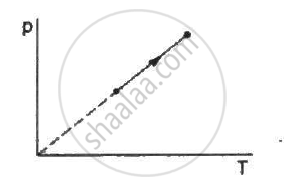
The process on an ideal gas, shown in figure, is
The average translational kinetic energy of air molecules is 0.040 eV (1 eV = 1.6 × 10⁻¹⁹J). Calculate the temperature of the air. Boltzmann constant k = 1.38 × 10⁻²³ J K−1.
At what temperature the mean speed of the molecules of hydrogen gas equals the escape speed from the earth?
Use R = 8.314 JK-1 mol-1
Figure shows two vessels A and B with rigid walls containing ideal gases. The pressure, temperature and the volume are pA, TA, V in the vessel A and pB, TB, V in the vessel B. The vessels are now connected through a small tube. Show that the pressure p and the temperature T satisfy `Ρ/T = 1/2 ({P_A}/{T_A}+{P_B}/{T_B))` when equilibrium is achieved.

Figure shows a cylindrical tube of cross-sectional area A fitted with two frictionless pistons. The pistons are connected to each other by a metallic wire. Initially, the temperature of the gas is T0 and its pressure is p0 which equals the atmospheric pressure. (a) What is the tension in the wire? (b) What will be the tension if the temperature is increased to 2T0 ?

An adiabatic cylindrical tube of cross-sectional area 1 cm2 is closed at one end and fitted with a piston at the other end. The tube contains 0.03 g of an ideal gas. At 1 atm pressure and at the temperature of the surrounding, the length of the gas column is 40 cm. The piston is suddenly pulled out to double the length of the column. The pressure of the gas falls to 0.355 atm. Find the speed of sound in the gas at atmospheric temperature.
When a gas is heated, its temperature increases. Explain this phenomenon on the basis of the kinetic theory of gases.
Find the kinetic energy of 5000 cc of a gas at STP, given the standard pressure is 1.013 × 10⁵ N/m2.
Energy is emitted from a hole in an electric furnace at the rate of 20 W when the temperature of the furnace is 727°C. What is the area of the hole? (Take Stefan’s constant σ to be 5.7 × 10⁻⁸ Js-1 m-2K-4.)
Earth’s mean temperature can be assumed to be 280 K. How will the curve of blackbody radiation look like for this temperature? Find out λmax. In which part of the electromagnetic spectrum, does this value lie? (Take Wien's constant b = 2.897 × 10⁻³ m K)
The number of degrees of freedom, for the vibrational motion of a polyatomic molecule, depends on the ______
If the density of nitrogen is 1.25 kg/m3 at a pressure of 105 Pa, find the root mean square velocity of nitrogen molecules.
Average kinetic energy of H2 molecule at 300K is 'E'. At the same temperature, average kinetic energy of O2 molecule will be ______.
Two molecules of a gas have speeds of 9 × 10 6 ms−1 and 1 × 10⁶ ms−1, respectively. What is the root mean square speed of these molecules?
A gas mixture consists of molecules of types A, B and C with masses mA > mB > mC. Rank the three types of molecules in decreasing order of average K.E.
Assuming the expression for the pressure P exerted by an ideal gas, prove that the kinetic energy per unit volume of the gas is `3/2` P.
