Advertisements
Advertisements
Question
The temperature and pressure at Simla are 15.0°C and 72.0 cm of mercury and at Kalka these are 35.0°C and 76.0 cm of mercury. Find the ratio of air density at Kalka to the air density at Simla.
Use R=8.314J K-1 mol-1
Advertisements
Solution
Here,
Temperature in Simla, T1= 15 + 273 = 288 K
Pressure in Simla, P1 = 0.72 m of Hg
Temperature in Kalka, T2= 35+273 = 308 K
Pressure in Kalka, P2 = 0.76 m of Hg
Let density of air at Simla and Kalka be ρ1 and ρ2 respectively. Then,
\[PV = \frac{m}{M}RT\]
\[ \Rightarrow \frac{m}{V} = \frac{PM}{RT}\]
\[ \Rightarrow \rho = \frac{PM}{RT}\]
Thus, \[\rho_1 = \frac{P_1 M}{R T_1}\]
\[\rho_2 = \frac{P_2 M}{R T_2}\]
Taking ratios , we get
\[\frac{\rho_1}{\rho_2} = \frac{P_1}{T_1} \times \frac{T_2}{P_2}\]
\[ \Rightarrow \frac{\rho_1}{\rho_2} = \frac{0 . 72}{288} \times \frac{308}{0 . 76}\]
\[ \Rightarrow \frac{\rho_2}{\rho_1} = 0 . 987\]
APPEARS IN
RELATED QUESTIONS
When we place a gas cylinder on a van and the van moves, does the kinetic energy of the molecules increase? Does the temperature increase?
Consider a gas of neutrons. Do you expect it to behave much better as an ideal gas as compared to hydrogen gas at the same pressure and temperature?
The mean square speed of the molecules of a gas at absolute temperature T is proportional to
Find the number of molecules of an ideal gas in a volume of 1.000 cm3 at STP.
A gas cylinder has walls that can bear a maximum pressure of 1.0 × 10⁶ Pa. It contains a gas at 8.0 × 10⁵ Pa and 300 K. The cylinder is steadily heated. Neglecting any change in the volume, calculate the temperature at which the cylinder will break.
Figure shows two vessels A and B with rigid walls containing ideal gases. The pressure, temperature and the volume are pA, TA, V in the vessel A and pB, TB, V in the vessel B. The vessels are now connected through a small tube. Show that the pressure p and the temperature T satisfy `Ρ/T = 1/2 ({P_A}/{T_A}+{P_B}/{T_B))` when equilibrium is achieved.

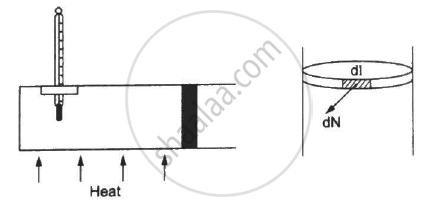
Figure shows a cylindrical tube of radius 5 cm and length 20 cm. It is closed by a tight-fitting cork. The friction coefficient between the cork and the tube is 0.20. The tube contains an ideal gas at a pressure of 1 atm and a temperature of 300 K. The tube is slowly heated and it is found that the cork pops out when the temperature reaches 600 K. Let dN denote the magnitude of the normal contact force exerted by a small length dlof the cork along the periphery (see the figure). Assuming that the temperature of the gas is uniform at any instant, calculate `(dN)/(dt)`.
Compare the rms speed of hydrogen molecules at 127°C with rms speed of oxygen molecules at 27ºC given that molecular masses of hydrogen and oxygen are 2 and 32 respectively.
If the density of nitrogen is 1.25 kg/m3 at a pressure of 105 Pa, find the root mean square velocity of nitrogen molecules.
Explain in detail the kinetic interpretation of temperature.
Assuming the expression for the pressure exerted by the gas on the wall of the container, it can be shown that pressure is ______.
An ideal gas in a container of volume 500 cc is at a pressure of 2 × 10⁵ N/m2. The average kinetic energy of each molecule is 6 × 10⁻²¹ J. The number of gas molecules in the container is ______.
The molecules of a given mass of a gas have root mean square speeds of 100 ms−1 at 27°C and 1.00 atmospheric pressure. What will be the root mean square speeds of the molecules of the gas at 127°C and 2.0 atmospheric pressure?
A gas mixture consists of molecules of types A, B and C with masses mA > mB > mC. Rank the three types of molecules in decreasing order of average K.E.
23Ne decays to 23Na by negative beta emission. Mass of 23Ne is 22.994465 amu mass of 23Na is 22.989768 amu. The maximum kinetic energy of emitted electrons neglecting the kinetic energy of recoiling product nucleus is ______ MeV.
When a particle oscillates simple harmonically, its kinetic energy varies periodically. If frequency of the particle is n, then the frequency of the kinetic energy is ______.
Which of the following materials is diathermanous?
Show that the average energy per molecule is directly proportional to the absolute temperature ‘T’ of the gas.
