Advertisements
Advertisements
प्रश्न
The temperature and pressure at Simla are 15.0°C and 72.0 cm of mercury and at Kalka these are 35.0°C and 76.0 cm of mercury. Find the ratio of air density at Kalka to the air density at Simla.
Use R=8.314J K-1 mol-1
Advertisements
उत्तर
Here,
Temperature in Simla, T1= 15 + 273 = 288 K
Pressure in Simla, P1 = 0.72 m of Hg
Temperature in Kalka, T2= 35+273 = 308 K
Pressure in Kalka, P2 = 0.76 m of Hg
Let density of air at Simla and Kalka be ρ1 and ρ2 respectively. Then,
\[PV = \frac{m}{M}RT\]
\[ \Rightarrow \frac{m}{V} = \frac{PM}{RT}\]
\[ \Rightarrow \rho = \frac{PM}{RT}\]
Thus, \[\rho_1 = \frac{P_1 M}{R T_1}\]
\[\rho_2 = \frac{P_2 M}{R T_2}\]
Taking ratios , we get
\[\frac{\rho_1}{\rho_2} = \frac{P_1}{T_1} \times \frac{T_2}{P_2}\]
\[ \Rightarrow \frac{\rho_1}{\rho_2} = \frac{0 . 72}{288} \times \frac{308}{0 . 76}\]
\[ \Rightarrow \frac{\rho_2}{\rho_1} = 0 . 987\]
APPEARS IN
संबंधित प्रश्न
If the molecules were not allowed to collide among themselves, would you expect more evaporation or less evaporation?
Is it possible to boil water at room temperature, say 30°C? If we touch a flask containing water boiling at this temperature, will it be hot?
When you come out of a river after a dip, you feel cold. Explain.
The mean square speed of the molecules of a gas at absolute temperature T is proportional to
Find the number of molecules of an ideal gas in a volume of 1.000 cm3 at STP.
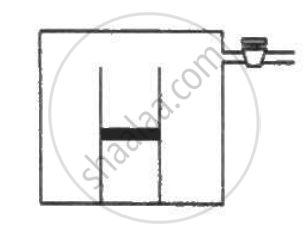
An ideal gas is kept in a long cylindrical vessel fitted with a frictionless piston of cross-sectional area 10 cm2 and weight 1 kg in figure. The vessel itself is kept in a big chamber containing air at atmospheric pressure 100 kPa. The length of the gas column is 20 cm. If the chamber is now completely evacuated by an exhaust pump, what will be the length of the gas column? Assume the temperature to remain constant throughout the process.
The temperature and the dew point in an open room are 20°C and 10°C. If the room temperature drops to 15°C, what will be the new dew point?
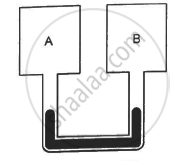
Figure shows two rigid vessels A and B, each of volume 200 cm3, containing an ideal gas (Cv = 12.5 J K−1 mol−1). The vessels are connected to a manometer tube containing mercury. The pressure in both the vessels is 75 cm of mercury and the temperature is 300 K. (a) Find the number of moles of the gas in each vessel. (b) 5.0 J of heat is supplied to the gas in vessel A and 10 J to the gas in vessel B. Assuming there's no appreciable transfer of heat from A to B, calculate the difference in the heights of mercury in the two sides of the manometer. Gas constant, R = 8.3 J K−1 mol−1.
A glass contains some water at room temperature 20°C. Refrigerated water is added to it slowly. when the temperature of the glass reaches 10°C, small droplets condense on the outer surface. Calculate the relative humidity in the room. The boiling point of water at a pressure of 17.5 mm of mercury is 20°C and at 8.9 mm of mercury it is 10°C.
Answer in brief:
What will happen to the mean square speed of the molecules of a gas if the temperature of the gas increases?
Answer in brief:
Show that rms velocity of an oxygen molecule is `sqrt2` times that of a sulfur dioxide molecule at S.T.P.
Earth’s mean temperature can be assumed to be 280 K. How will the curve of blackbody radiation look like for this temperature? Find out λmax. In which part of the electromagnetic spectrum, does this value lie? (Take Wien's constant b = 2.897 × 10⁻³ m K)
The average K.E. of hydrogen molecules at 27° C is E. The average K.E. at 627° C is ____________.
The molecules of a given mass of a gas have root mean square speeds of 100 ms−1 at 27°C and 1.00 atmospheric pressure. What will be the root mean square speeds of the molecules of the gas at 127°C and 2.0 atmospheric pressure?
Two molecules of a gas have speeds of 9 × 10 6 ms−1 and 1 × 10⁶ ms−1, respectively. What is the root mean square speed of these molecules?
Consider a rectangular block of wood moving with a velocity v0 in a gas at temperature T and mass density ρ. Assume the velocity is along x-axis and the area of cross-section of the block perpendicular to v0 is A. Show that the drag force on the block is `4ρAv_0 sqrt((KT)/m)`, where m is the mass of the gas molecule.
If a = 0. 72 and r = 0.24, then the value of t is ______.
Show that the average energy per molecule is directly proportional to the absolute temperature ‘T’ of the gas.
