Advertisements
Advertisements
प्रश्न
The temperature and pressure at Simla are 15.0°C and 72.0 cm of mercury and at Kalka these are 35.0°C and 76.0 cm of mercury. Find the ratio of air density at Kalka to the air density at Simla.
Use R=8.314J K-1 mol-1
Advertisements
उत्तर
Here,
Temperature in Simla, T1= 15 + 273 = 288 K
Pressure in Simla, P1 = 0.72 m of Hg
Temperature in Kalka, T2= 35+273 = 308 K
Pressure in Kalka, P2 = 0.76 m of Hg
Let density of air at Simla and Kalka be ρ1 and ρ2 respectively. Then,
\[PV = \frac{m}{M}RT\]
\[ \Rightarrow \frac{m}{V} = \frac{PM}{RT}\]
\[ \Rightarrow \rho = \frac{PM}{RT}\]
Thus, \[\rho_1 = \frac{P_1 M}{R T_1}\]
\[\rho_2 = \frac{P_2 M}{R T_2}\]
Taking ratios , we get
\[\frac{\rho_1}{\rho_2} = \frac{P_1}{T_1} \times \frac{T_2}{P_2}\]
\[ \Rightarrow \frac{\rho_1}{\rho_2} = \frac{0 . 72}{288} \times \frac{308}{0 . 76}\]
\[ \Rightarrow \frac{\rho_2}{\rho_1} = 0 . 987\]
APPEARS IN
संबंधित प्रश्न
Consider a gas of neutrons. Do you expect it to behave much better as an ideal gas as compared to hydrogen gas at the same pressure and temperature?
Which of the following parameters is the same for molecules of all gases at a given temperature?
The average translational kinetic energy of air molecules is 0.040 eV (1 eV = 1.6 × 10⁻¹⁹J). Calculate the temperature of the air. Boltzmann constant k = 1.38 × 10⁻²³ J K−1.
Air is pumped into the tubes of a cycle rickshaw at a pressure of 2 atm. The volume of each tube at this pressure is 0.002 m3. One of the tubes gets punctured and the volume of the tube reduces to 0.0005 m3. How many moles of air have leaked out? Assume that the temperature remains constant at 300 K and that the air behaves as an ideal gas.
Use R = 8.3 J K-1 mol-1
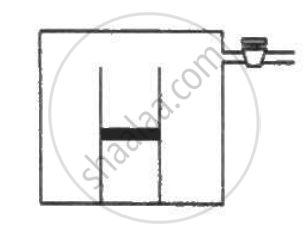
An ideal gas is kept in a long cylindrical vessel fitted with a frictionless piston of cross-sectional area 10 cm2 and weight 1 kg in figure. The vessel itself is kept in a big chamber containing air at atmospheric pressure 100 kPa. The length of the gas column is 20 cm. If the chamber is now completely evacuated by an exhaust pump, what will be the length of the gas column? Assume the temperature to remain constant throughout the process.
Answer in brief:
Show that rms velocity of an oxygen molecule is `sqrt2` times that of a sulfur dioxide molecule at S.T.P.
When a gas is heated, its temperature increases. Explain this phenomenon on the basis of the kinetic theory of gases.
The emissive power of a sphere of area 0.02 m2 is 0.5 kcal s-1m-2. What is the amount of heat radiated by the spherical surface in 20 seconds?
Why the temperature of all bodies remains constant at room temperature?
Explain in detail the kinetic interpretation of temperature.
A molecule consists of two atoms each of mass 'm' and separated by a distance 'd'. At room temperature the average rotational kinetic energy is 'E', then its angular frequency is ______.
A cylinder containing an ideal gas is in vertical position and has a piston of mass M that is able to move up or down without friction (Figure). If the temperature is increased ______.

23Ne decays to 23Na by negative beta emission. Mass of 23Ne is 22.994465 amu mass of 23Na is 22.989768 amu. The maximum kinetic energy of emitted electrons neglecting the kinetic energy of recoiling product nucleus is ______ MeV.
A proton, a deuteron and an α-particle with same kinetic energy enter into a uniform magnetic field at right angle to magnetic field. The ratio of the radii of their respective circular paths is ______.
When a particle oscillates simple harmonically, its kinetic energy varies periodically. If frequency of the particle is n, then the frequency of the kinetic energy is ______.
Assuming the expression for the pressure P exerted by an ideal gas, prove that the kinetic energy per unit volume of the gas is `3/2` P.
If a = 0. 72 and r = 0.24, then the value of t is ______.
Show that the average energy per molecule is directly proportional to the absolute temperature ‘T’ of the gas.
