Advertisements
Advertisements
Question
The transfer of genetic material from one bacterium to another through the mediation of a viral vector is termed as ______.
Options
Transduction
Conjugation
Transformation
Translation
Advertisements
Solution
The transfer of genetic material from one bacterium to another through the mediation of a viral vector is termed as transduction.
APPEARS IN
RELATED QUESTIONS
How has the development of bioreactor helped in biotechnology?
Name the most commonly used bioreactor and describe its working.
Explain the mechanism of action of restriction endonucleases that makes them suitable for genetic engineering.
The enzyme restriction endonuclease ______.
Alu-I is obtained from which organism?
Identify the characters that a cloning vector should possess.
i. Origin of replication (Ori)
ii. Ability to destroy the alien DNA
ii. Cloning site to link the alien DNA
iv. The tumour inducing plasmid Ti
v. Selectable marker
vi. Low molecular weight
Identify the CORRECT sequence of steps in PCR.
For which of the following purpose restriction endonuclease enzyme is used in genetic engineering?
From which of the following organisms the enzyme Taq polymerase used in PCR technique is obtained?
Following are the four statements regarding separation of DNA fragments using Gel electrophoresis. Identify the INCORRECT statements.
i. DNA is negatively charged molecule and so it is loaded on gel towards the Anode terminal.
ii. DNA fragments travel along the surface of the gel whose concentration does not affect movement of DNA.
iii. Smaller the size of DNA fragment, larger is the distance it travels through it.
iv. Pure DNA can be visualized directly by exposing to UV radiation.
Name a recombinant vaccine that is currently being used in vaccination programme.
What would happen when one grows a recombinant bacterium in a bioreactor but forget to add antibiotic to the medium in which the recombinant is growing?
Which of the following is the correct recognition sequence of restriction enzyme Eco RI?
Expand the following acronym:
BAC
Importance of PCR.
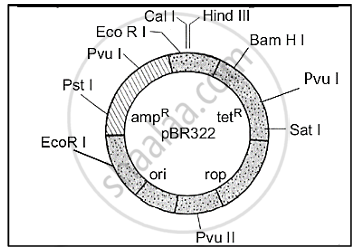
Study the diagram given below and answer the questions that follow.

- Name the cloning vector shown above. In which organism in this cloning vector inserted?
-
Mention any two restriction sites shown in the diagram.
- Name any two selectable markers shown in the diagram.
David is a molecular biologist. He uses a technique to know the amino acids occupy the first and the last positions in the Chain - A and Chain - B of insulin. Name the scientist whose contribution made it possible for David to use this technique.
Give a reason for the following:
The diagram given below represents vector pBr322 which was modified by a research scholar Dr. Rayon, but the vector was rejected by his guide.
The manipulation of genetic material towards a desired end using "in-vitro" process is called______.
