Advertisements
Advertisements
Question
The sum of two natural numbers is 15 and the sum of their reciprocals is `3/10`. Find the numbers.
Advertisements
Solution 1
Let the two numbers be x and y.
According to the question,
x + y = 15
`\implies` y = 15 – x ...(i)
and `1/x + 1/y = 3/10`
`\implies 1/x + 1/(15 - x) = 3/10` ...(From (i))
`\implies (15 - x + x)/(x(15 - x)) = (3)/(10)`
`\implies` 15 × 10 = 3x(15 – x)
`\implies` 150 = 45x – 3x2
`\implies` 3x2 – 45x + 150 = 0
`\implies` x2 – 15x + 50 = 0
`\implies` x2 – 10x – 5x + 50 = 0
`\implies` x(x – 10) – 5(x – 10) = 0
`\implies` x – 10 = 0 or x – 5 = 0
`\implies` x = 10 or x = 5
Hence, the numbers are 10, 5.
Solution 2
Let the required natural numbers be x and `(15-x)`
According to the given condition
`1/x+1/(15-x)=3/10`
⇒`(15-x+x)/(x(15-x))=3/10`
⇒`15/(15x-x^2)=3/10`
⇒`15x-x^2+50=0`
⇒`x^2-15x+50=0`
⇒`x^2-10x-5x+50=0`
⇒`x(x-10)-5(x-10)=0`
⇒`(x-5) (x-10)=0`
⇒`x-5=0 or x-10=0`
⇒`x=5 or x=10`
When `x=5`
`15-x=15-5=10`
When `x=10`
`15-x=15-10=5`
Hence, the required natural numbers are 5 and 10.
APPEARS IN
RELATED QUESTIONS
Solve the equation `3/(x+1)-1/2=2/(3x-1);xne-1,xne1/3,`
Solve the following quadratic equations by factorization:
`(x+3)/(x-2)-(1-x)/x=17/4`
Solve the following quadratic equations by factorization:
`(x-1)/(2x+1)+(2x+1)/(x-1)=5/2` , x ≠ -1/2, 1
A fast train takes one hour less than a slow train for a journey of 200 km. If the speed of the slow train is 10 km/hr less than that of the fast train, find the speed of the two trains.
If two pipes function simultaneously, a reservoir will be filled in 12 hours. One pipe fills the reservoir 10 hours faster than the other. How many hours will the second pipe take to fill the reservoir?
Some students planned a picnic. The budget for food was Rs. 500. But, 5 of them failed to go and thus the cost of food for each member increased by Rs. 5. How many students attended the picnic?
Solve : x2 – 11x – 12 =0; when x ∈ N
Solve each of the following equations by factorization:
`x+1/x=2.5`
`x^2+8x-2=0`
Solve the following quadratic equation by
factorisation.
5m2 = 22m + 15
Show that x = −3 is a solution of x2 + 6x + 9 = 0.
Show that x = −2 is a solution of 3x2 + 13x + 14 = 0.
Find the discriminant of the quadratic equation \[3\sqrt{3} x^2 + 10x + \sqrt{3} = 0\].
If the equations \[\left( a^2 + b^2 \right) x^2 - 2\left( ac + bd \right)x + c^2 + d^2 = 0\] has equal roots, then
Solve the following equation: c
Solve the following equation :
`("x" - 1)/("x" - 2) + ("x" - 3)/("x" - 4) = 3 1/3`
Find two natural numbers which differ by 3 and whose squares have the sum of 117.
Three years ago, a man was 5 times the age of his son. Four years hence, he will be thrice his son's age. Find the present ages of the man and his son.
The hypotenuse of a right-angled triangle is 17cm. If the smaller side is multiplied by 5 and the larger side is doubled, the new hypotenuse will be 50 cm. Find the length of each side of the triangle.
An aeroplane travelled a distance of 400 km at an average speed of x km/hr. On the return journey the speed was increased by 40 km/hr. Write down the expression for the time taken for
the return Journey. If the return journey took 30 minutes less than the onward journey write down an equation in x and find its value.
In each of the following determine whether the given values are solutions of the equation or not
2x2 - 6x + 3 = 0; x = `(1)/(2)`
In each of the following determine whether the given values are solutions of the equation or not.
x2 + x + 1 = 0; x = 1, x = -1.
Solve the following equation by factorization
`x + (1)/x = 2(1)/(20)`
Solve the following equation by factorization
`x/(x - 1) + (x - 1)/x = 2(1)/(2)`
Two pipes running together can fill a tank in `11(1)/(9)` minutes. If one pipe takes 5 minutes more than the other to fill the tank, find the time in which each pipe would/fill the tank.
The speed of a boat in still water is 11 km/ hr. It can go 12 km up-stream and return downstream to the original point in 2 hours 45 minutes. Find the speed of the stream
If Zeba were younger by 5 years than what she really is, then the square of her age (in years) would have been 11 more than five times her actual age. What is her age now?
In the centre of a rectangular lawn of dimensions 50 m × 40 m, a rectangular pond has to be constructed so that the area of the grass surrounding the pond would be 1184 m2 [see figure]. Find the length and breadth of the pond.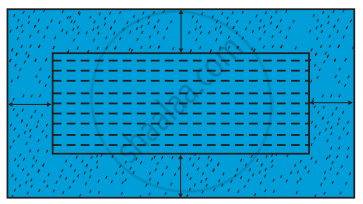
If α and β are roots of the quadratic equation x2 – 7x + 10 = 0, find the quadratic equation whose roots are α2 and β2.
Using quadratic formula find the value of x.
p2x2 + (p2 – q2)x – q2 = 0
