Advertisements
Advertisements
Question
The following graph shows the number of visitors (in millions) visiting the famous Salarjung Museum in Hyderabad between 2000 and 2010 as well as the number of visitors expected to visit it in the next ten years.

Advertisements
Solution
Number of Visitors to the Salarjung Museum (Hyderabad) in Millions
We can describe the information in the graph in the following way:
(Study the verb forms carefully)
In 2000, the number of students visiting the museum was 2. 75 million.
By 2010 the number had risen to 4 million.
If we are referring to figures for the current year we can say:
The number has risen marginally.
If we are predicting figures for the future we can say:
By 2020, the number will have risen to 7 million students OR
It is estimated /predicted that the number will rise to ........ .
APPEARS IN
RELATED QUESTIONS
A1. Information Transfer (Non-verbal to verbal)
'Transfer the following information into a paragraph form.
Manuscripts collected from both students and teachers.
↓
Throughly screened, necessary additions, alterations. omissions are made.
↓
Preparing a rough draft
↓
Manuscripts along with a dummy sent to the printer
↓
Proof correction
↓
Sent for final printing
OR
A2. Here are some tips about keeping healthy as given in a Science magazine. Read and
write in the form of Do's and Don'ts (table):
You must include vegetables and fruits in your diet and drink a lot of water. You should avoid junk food and aerated water. You shouldn't sit for long period of time. Rather you should exercise regularly. You shouldn't ignore the importance of good breathing habits. Try breathing deeply whenever you think of it. See to it that you leep for at least 7 hour a day. In fact, you should avoid irregular timings.
Read the following tree diagram about 'Morphemes' and write a short paragraph on it.

Read the following extract and extend it by adding an imaginary paragraph of your own in about 120 words:
[You may begin with: Mrs. Green: May I come in.......]
"May I come in?" asked the pink lady.
"Please come in," said my mother. "Do sit down. Do you require a room'?"
"Not today, thank you. I'm staying with Padre Dutt.
He insisted on putting me up. But I may want room for a day or two -- lust for old time's sake."
"You've stayed here before."
''A long time ago. I'm Mrs. Green, you know. The missing
Mrs. Green. The one for whom you put up that handsome tombstone in the cemetery. I was very touched by it. And I'm glad you didn't add 'Beloved wife of Henry Green' because I didn't' love him any more than he loved me.''
''Then - then - you aren't the skeleton?'' stammered my
mother.
''Do I look like a skeleton?''
''No!'' we said together.
· ''But we heard you disappeared,'' I said, ''and when we found that skeleton -''
''You put two and two together.''
''Well, it was Miss Kellner who convinced us,'' said my
mother. ''And you did disappear mysteriously. You were missing for years. And everyone knew Mr. Green was a philanderer!''
''Couldn't wait to get away from him," said the pink lady.
'Couldn't stand him anymore. He was a lady-killer, but not a real killer.''
''But your father ca1ne looking for you. Didn't you get in touch with him?''
Question:
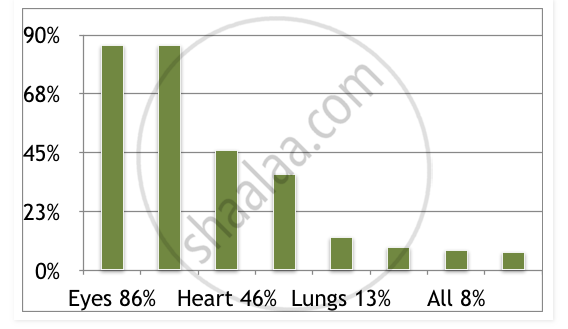
Read the following graph regarding ‘High Awareness but Little Action’ about organ donation. Write a paragraph based on it in about 120 words:
Information Transfer :Non-verbal to Verbal
Read the information on the life history of Kalpana Chawla. On the basis of given points write two short paragraphs on her life history. Suggest a suitable title.
Kalpana Chawla : The first Indian woman in space.
Born : 1961, Karnal, a small town of Haryana.
Schooling : Tagore Bal Niketan, Karnal (1976). B.E from Punjab Engineering College, Chandigarh.
1984 : Master’s degree in Aerospace Engineering – University of Texas
1986 : Ph.D in Aerospace Engineering – University of Colorado
1995 : Picked up for the space programme by NASA.
1997 : Became the first Indian American in space
January 2003 : Went abroad her second space shuttle Columbia to study the outer atmosphere of the sun.
1st February 2003 : Space shuttle lost contact and crashed claiming Kalpana’s life with six fellow astronauts.Read the information on the life history of Kalpana Chawla. On the basis of given points write two short paragraphs on her life history. Suggest a suitable title.
Kalpana Chawla : The first Indian woman in space.
Born : 1961, Karnal, a small town of Haryana.
Schooling : Tagore Bal Niketan, Karnal (1976). B.E from Punjab Engineering College, Chandigarh.
1984 : Master’s degree in Aerospace Engineering – University of Texas
1986 : Ph.D in Aerospace Engineering – University of Colorado
1995 : Picked up for the space programme by NASA.
1997 : Became the first Indian American in space
January 2003 : Went abroad her second space shuttle Columbia to study the outer atmosphere of the sun.
1st February 2003 : Space shuttle lost contact and crashed claiming Kalpana’s life with six fellow astronauts.Read the information on the life history of Kalpana Chawla. On the basis of given points write two short paragraphs on her life history. Suggest a suitable title.
Kalpana Chawla : The first Indian woman in space.
Born : 1961, Karnal, a small town of Haryana.
Schooling : Tagore Bal Niketan, Karnal (1976). B.E from Punjab Engineering College, Chandigarh.
1984 : Master’s degree in Aerospace Engineering – University of Texas
1986 : Ph.D in Aerospace Engineering – University of Colorado
1995 : Picked up for the space programme by NASA.
1997 : Became the first Indian American in space
January 2003 : Went abroad her second space shuttle Columbia to study the outer atmosphere of the sun.
1st February 2003 : Space shuttle lost contact and crashed claiming Kalpana’s life with six fellow astronauts.
Verbal to Non-verbal
Read the following paragraph and convert it into a tree diagram:
|
Two common types of oils are animal oil and vegetable oil. Vegetable oils are extracted from different plant parts such as seeds, nuts and the flesh of fruits. They are widely used in cooking. From very ancient times they have been used in households for various reasons. The oils of certain flowers are extracted to make perfumes. Vegetable oils such as castor oil are used as medicine and as lubricants. In recent times, there have been debates on using waste vegetable oils as fuel. |
The chart below shows information on the economics of the Annual
Sports Meet. Study the chart carefully.
| The Economics of the Annual Sports Meet |
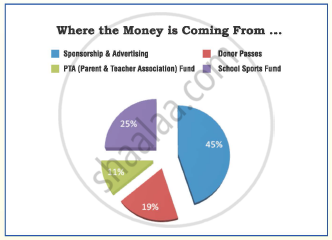
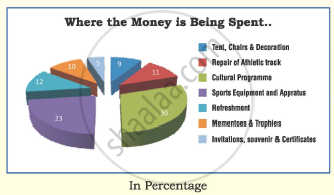
The total cost estimated of the Meet will be~ 11, 00, 000/-
No of athletes : 1250 (750 Girls+ 500 Boys; Category wise: sub-junior: 350, junior: 500 and senior: 400)
Staff on Duty : Teachers: 95 (35 men + 60 women), Support Staff 40 (21 men + 19 women), Staff on Parking and Security duty : 25 (20 men+ 5 women)
No of events : 100 ( 70 Track & Field events and 30 Jumps and Throws)
Medals : 100 Gold, 100Silver& 100Bronze
Best Athlete Trophies : Boys: 3, Girls: 3
Best House Trophies : 4( 1 for each category and 1 over all)
Suppose you are the Prin cipal of the school. Taking information from the chart, prepare an oral presentation for the Management Committee of the school. Use as many expressions of comparison as you can. You have been given some examples.
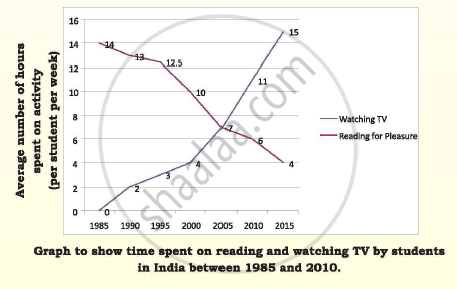
The graph below describes the average number of hours spent by students aged 11-15 years on two activities (per student per week) in India between 1985 and 2010 and gives projections for 2015. Study the information carefully and then write a paragraph interpreting the data. Include the following:
• A comparison of the trends in the two activities
• A comparison of the situation in 1985
• A comparison of the situation between 1985 and 2010
• Predictions for the future
Observe the following table and transfer the information into a paragraph:
Statewise Distribution of Urban and Rural Population in India:
| States | Population in Millions | |
| Rural | Urban | |
| Maharashtra | 560 | 410 |
| Gujarat | 320 | 190 |
| Madhya Pradesh | 440 | 160 |
| Chhattisgarh | 170 | 40 |
| Andhra Pradesh | 550 | 210 |
| Karnataka | 350 | 180 |
Read the following passage and complete the table
Dialect is a form of a language spoken in one area which may be different from other forms of the same language. Each language has dialects which change every few kilometers. India is a multi-lingual country. Each state follows its own language as official language. For example, Marathi is the official language of Maharashtra, while Ahirani, Wharadi, Konkani and Malwani are its dialects. Several languages in India are spoken but do not have any script. In Karnataka, Kannada is the official language. Tulu is spoken in Karnataka but has no script. In England, English is the official language while Scottish, spoken in Scotland and Welsh spoken in Wales are dialects of English.
| State | Official language | Dialects | Spoken/ Without script |
| Maharashtra | Marathi | ||
| Karnataka | |||
| England |
Read the following text and present the information in a tabular form:
Raja Ram Mohan Roy was a zealous social worker holding modern and progressive views. He firmly stood against social bigotry, conservation, and superstition and advocated English and Western Education for his fellowmen. He knew many languages viz English, Persian, Arabic, Latin, French, and even Hebrew. He was born in 1772 in West Bengal. He joined East India Company in 1805. The title ‘Raja’ was conferred on Ram Mohan Roy by the Mogul Emperor. In 1814 he founded the Atmiya Sabha and in 1828 the ‘Brahmo Samaj’. He abolished ‘sati’, child marriage and the purdah. He is rightly called the ‘father of Indian Renaissance’ or the ‘Father of Indian Nationalism’. He died on 27 Sept. 1833 in England.
| Name: | |
| Date of Birth: | |
| III practices abolished: | |
| Institutions launched: | |
| Languages Known: |
Read the following paragraph and transfer the information in the form of a tree diagram:
The United Nations was established at the end of the second world war to maintain international peace and security.
In the central system of the UN, there are 15 members of the Security Council. The Economic and Social Council has 54 members. The Secretariat of the United Nations is headed by Secretary-General.
The UN has several specialized agencies such as the World Health Organisation (WHO), the Food and Agricultural Organisation (FAO), the International Labour Organization (ILO), the United Nations Educational, Scientific and Cultural Organisation (UNESCO).
Observe the following web diagram carefully and convert it into a paragraph.

Read the given extract carefully and transfer the following into a flow chart:
Garbage disposal has become a great problem in urban areas. A lot of garbage is being collected from every household. Some cities have come up with innovative ideas to tackle this problem. First of all, the garbage in trucks is segregated into organic waste from recyclable waste. Then it is put in separate containers.
Earthworm culture is added to this organic waste. After a few weeks the conversion process is complete and what we can get is vermicompost which is a very good quality compost that can be mixed with soil and used for better yields.
Verbal to Non-Verbal:
Read the following information and complete the following table below it:
Chandrayaan-2, India’s second mission to the Moon will, for the first time, unravel secrets around the Moon’s the South Pole. Chandrayaan-2 is a three-part spacecraft - an orbiter, a lander, and a rover. The lander is named Vikram after Vikram Sarabhai, the founder of the Indian space programme. The rover is named Pragyan, meaning ‘wisdom’.
Chandrayaan-2 was launched on 22 July atop ISRO’s GSLV Mk-III at 2:43 p.m. from the Satish Dhawan Space Centre at Sriharikota. Performing as expected, the rocket released Chandrayaan-2 in a highly elliptic orbit around Earth about 17 minutes later. In fact, it was released 6,000 km higher than planned. The solar arrays on Chandrayaan-2 deployed smoothly as the probe began its journey.
| Table | Information | |
| 1. | Name of the Mission | |
| 2. | Date of Launch | |
| 3. | Centre of Launch | |
| 4 | Name of the Rover | |
| 5. | Founder of Indian Space Programme |
Information Transfer:
1) Non-verbal to verbal:
Write two short paragraphs on ‘Village life’ by using the points given in the following web diagram:

OR
2) Verbal to Non-verbal:
Read the following paragraph and complete the table by putting in the correct information. Suggest a suitable title.
|
While preparing to plant trees in a residential colony, highways or anywhere, one should consider three factors for taking a decision. What kind of (species) trees, where to plant and what kind of soil. One should consider the qualities of a tree such as a pattern of branching and its height. |
Title: __________________________________
| Kinds of trees | Where to plant | Uses |
| 1) Shade-giving (short trees) |
________________ | a) Children climb and play b) Enjoy shade of a tree |
| 2) ___________ ______________ (tall trees) |
Residential colonies | a) Withstand the wind b) _____________ |
| 3) ______________ (native trees) |
Rode side/highway | a) Birds and animals interact more with the native trees. b) Villagers consider them sacred. |
Verbal to Non-verbal:
Write Do’s and Don’ts for ‘In the Examination Hall’. Suggest a suitable title.
You should carry all necessary materials for exam such as pens, pencils, erasers, scale, geometrical box etc. You should not forget your identity card and hall tickets. After you enter the examination hall, keep all required things on your desk. You should follow the instructions given by the invigilator. You must read the question paper carefully. You should avoid observing other students because their tension might disturb you. You need not feel upset even if you notice other students writing very speedily. You stay calm. In any case do not talk to any of the students during the exam. It’s advisable to drink sufficient water before you enter the exam hall. Last but not the least, don’t forget to check all answers in last 10 minutes, before submitting your answer sheet to the invigilator.
Transfer the information into a paragraph:
Observe the chart and write a paragraph on it. Suggest a suitable title:

Verbal to Non-verbal:
Read the following information and complete the given table below. Suggest a suitable title to it:
|
Chandrayaan-1 was India's first mission to the moon. It launched on Oct. 22, 2008 from the Satish Dhawan Space Centre in Sriharikota, India. Its scientific goals are to study the chemical, mineralogical and photogeological mapping of the moon. In addition to find out water on the moon. Then to perform high resolution remote sensing of the moon’s surface. The Chandrayaan-2 mission was successfully launched on 22nd July, 2019 from Satish Dhawan Space Centre, Sriharikota. The primary objectives were to demonstrate the ability to soft land and operate a robotic rover on the lunar surface. The mission was arranged to study the lunar topography, mineralogy, elemental abundance and the lunar ecosphere, conduct a detailed search for water and ice in polar region. Chandrayaan 2’s objectives are to find Chandrayaan-1 as reported by the ISRO. The mission targeted the “South Polar region” of the moon which was completely unexplored. The mission focused on the extensive mapping of the lunar surface for studying variations in its composition and tracing the moon's origin and evolution. Chandrayaan-3 launched to the moon on July 14, 2023 from the Satish Dhawan Space Centre in Sriharikota, India, the medium-life launch vehicle Mark-III (LVM3) rocket. The three main objectives of Chandrayaan-3 are to land safely on the surface, to demonstrate rover operations and to perform scientific experiments on site, according to the official website. |
Title: __________________
| Name of Chandrayaan | Date of launching | Objectives of Mission |
| Chandrayaan-1 | ||
| Chandrayaan-2 | ||
| Chandrayaan-3 |
