Advertisements
Advertisements
Question
Verbal to Non-verbal
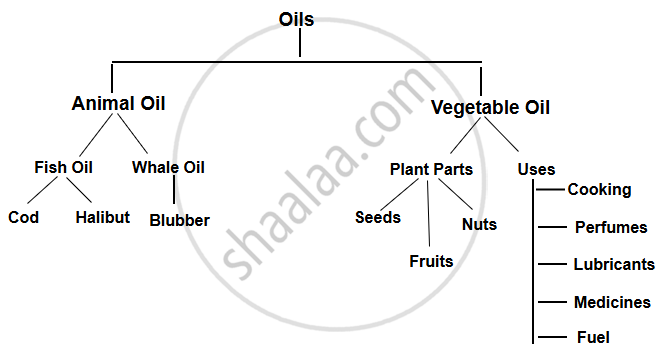
Read the following paragraph and convert it into a tree diagram:
|
Two common types of oils are animal oil and vegetable oil. Vegetable oils are extracted from different plant parts such as seeds, nuts and the flesh of fruits. They are widely used in cooking. From very ancient times they have been used in households for various reasons. The oils of certain flowers are extracted to make perfumes. Vegetable oils such as castor oil are used as medicine and as lubricants. In recent times, there have been debates on using waste vegetable oils as fuel. |
Advertisements
Solution
APPEARS IN
RELATED QUESTIONS

Information Transfer :Non-verbal to Verbal
Read the information on the life history of Kalpana Chawla. On the basis of given points write two short paragraphs on her life history. Suggest a suitable title.
Kalpana Chawla : The first Indian woman in space.
Born : 1961, Karnal, a small town of Haryana.
Schooling : Tagore Bal Niketan, Karnal (1976). B.E from Punjab Engineering College, Chandigarh.
1984 : Master’s degree in Aerospace Engineering – University of Texas
1986 : Ph.D in Aerospace Engineering – University of Colorado
1995 : Picked up for the space programme by NASA.
1997 : Became the first Indian American in space
January 2003 : Went abroad her second space shuttle Columbia to study the outer atmosphere of the sun.
1st February 2003 : Space shuttle lost contact and crashed claiming Kalpana’s life with six fellow astronauts.Read the information on the life history of Kalpana Chawla. On the basis of given points write two short paragraphs on her life history. Suggest a suitable title.
Kalpana Chawla : The first Indian woman in space.
Born : 1961, Karnal, a small town of Haryana.
Schooling : Tagore Bal Niketan, Karnal (1976). B.E from Punjab Engineering College, Chandigarh.
1984 : Master’s degree in Aerospace Engineering – University of Texas
1986 : Ph.D in Aerospace Engineering – University of Colorado
1995 : Picked up for the space programme by NASA.
1997 : Became the first Indian American in space
January 2003 : Went abroad her second space shuttle Columbia to study the outer atmosphere of the sun.
1st February 2003 : Space shuttle lost contact and crashed claiming Kalpana’s life with six fellow astronauts.Read the information on the life history of Kalpana Chawla. On the basis of given points write two short paragraphs on her life history. Suggest a suitable title.
Kalpana Chawla : The first Indian woman in space.
Born : 1961, Karnal, a small town of Haryana.
Schooling : Tagore Bal Niketan, Karnal (1976). B.E from Punjab Engineering College, Chandigarh.
1984 : Master’s degree in Aerospace Engineering – University of Texas
1986 : Ph.D in Aerospace Engineering – University of Colorado
1995 : Picked up for the space programme by NASA.
1997 : Became the first Indian American in space
January 2003 : Went abroad her second space shuttle Columbia to study the outer atmosphere of the sun.
1st February 2003 : Space shuttle lost contact and crashed claiming Kalpana’s life with six fellow astronauts.
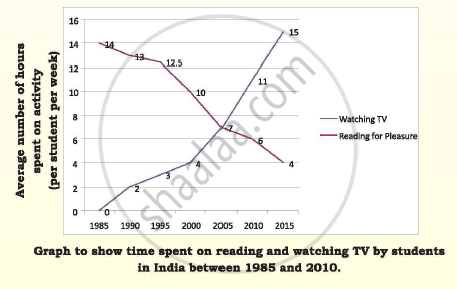
The graph below describes the average number of hours spent by students aged 11-15 years on two activities (per student per week) in India between 1985 and 2010 and gives projections for 2015. Study the information carefully and then write a paragraph interpreting the data. Include the following:
• A comparison of the trends in the two activities
• A comparison of the situation in 1985
• A comparison of the situation between 1985 and 2010
• Predictions for the future
Read the following passage and complete the table
Dialect is a form of a language spoken in one area which may be different from other forms of the same language. Each language has dialects which change every few kilometers. India is a multi-lingual country. Each state follows its own language as official language. For example, Marathi is the official language of Maharashtra, while Ahirani, Wharadi, Konkani and Malwani are its dialects. Several languages in India are spoken but do not have any script. In Karnataka, Kannada is the official language. Tulu is spoken in Karnataka but has no script. In England, English is the official language while Scottish, spoken in Scotland and Welsh spoken in Wales are dialects of English.
| State | Official language | Dialects | Spoken/ Without script |
| Maharashtra | Marathi | ||
| Karnataka | |||
| England |
Look at the table given below and write a short paragraph based on it in about 120 words :
The following table shows irregular rainfall causing low groundwater level in Nashik district, and Talukawise its worst hit villages.
| Drop in water level | Talukas | |||
| 0 to 1 meter | Nashik, Igatpuri, Niphad, Chandwad, Kalwan, Deola, Tryambakeshwar | |||
| 1 to 2 meters | Sinnar, Yeola, Nandgaon, Satana, Malegaon | |||
| Worst Hit Areas | ||||
| Talukas | Situation over coming months | |||
| Oct.-Dec. | Jan-Mar. | Apr.-June | Total | |
| Igatpuri | 01 | 06 | 49 | 56 |
| Malegaon | 31 | 54 | 37 | 122 |
| Nandgaon | 08 | 17 | 37 | 62 |
| Niphad | 01 | 04 | 47 | 52 |
| Source: Times of India, Nashik Times, City Edn. Date: Oct. 18, 2018 |
||||
Transfer the information into a paragraph about ‘Average Annual Tea Consumption Per Person’ as shown in the table given below :
| Nation | Turkey | Ireland | United Kingdom | Russia | Morocco | China | India |
| Tea consumption per person ( in Kg) | 3.15 | 2.19 | 1.94 | 1.38 | 1.21 | 0.57 | 0.32 |
Non-verbal to verbal:
Transfer the information into a paragraph.
Observe the web diagram and write a paragraph on it. Suggest a suitable title.

Study the concept chart from the self-help magazine section of a monthly publication.

Write a paragraph in not more than 120 words, analysing the listed responses to the situation when one faces setbacks.
A group of enterprising young adults conducted a survey on reopening of educational institutions in the National Capital.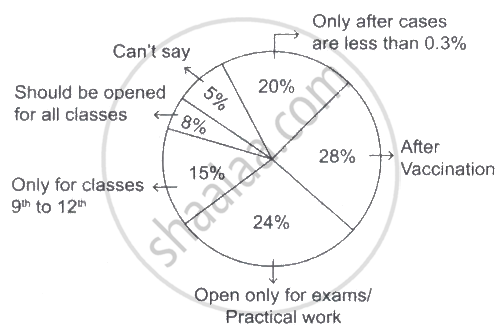
Write a paragraph in about 120 words analysing the listed responses.
Given below is a web diagram containing information about the different means of electronic devices of entertainment-some audio, some visual and some audio-visual.
Write a short paragraph based on information from the web. Give a suitable title to it.

